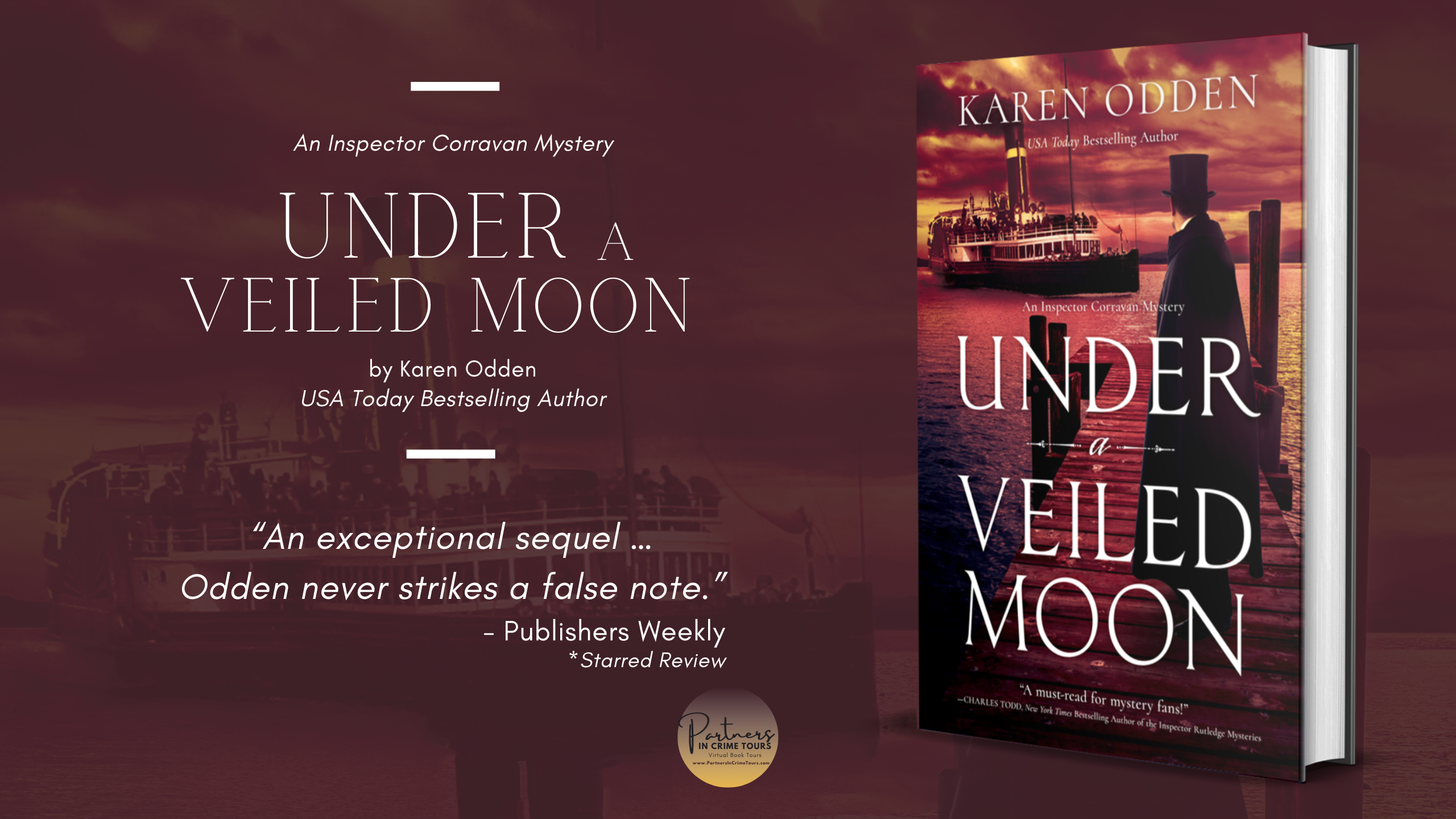
Under a Veiled Moon
by Karen Odden
January 2-27, 2023 Virtual Book Tour
Synopsis:
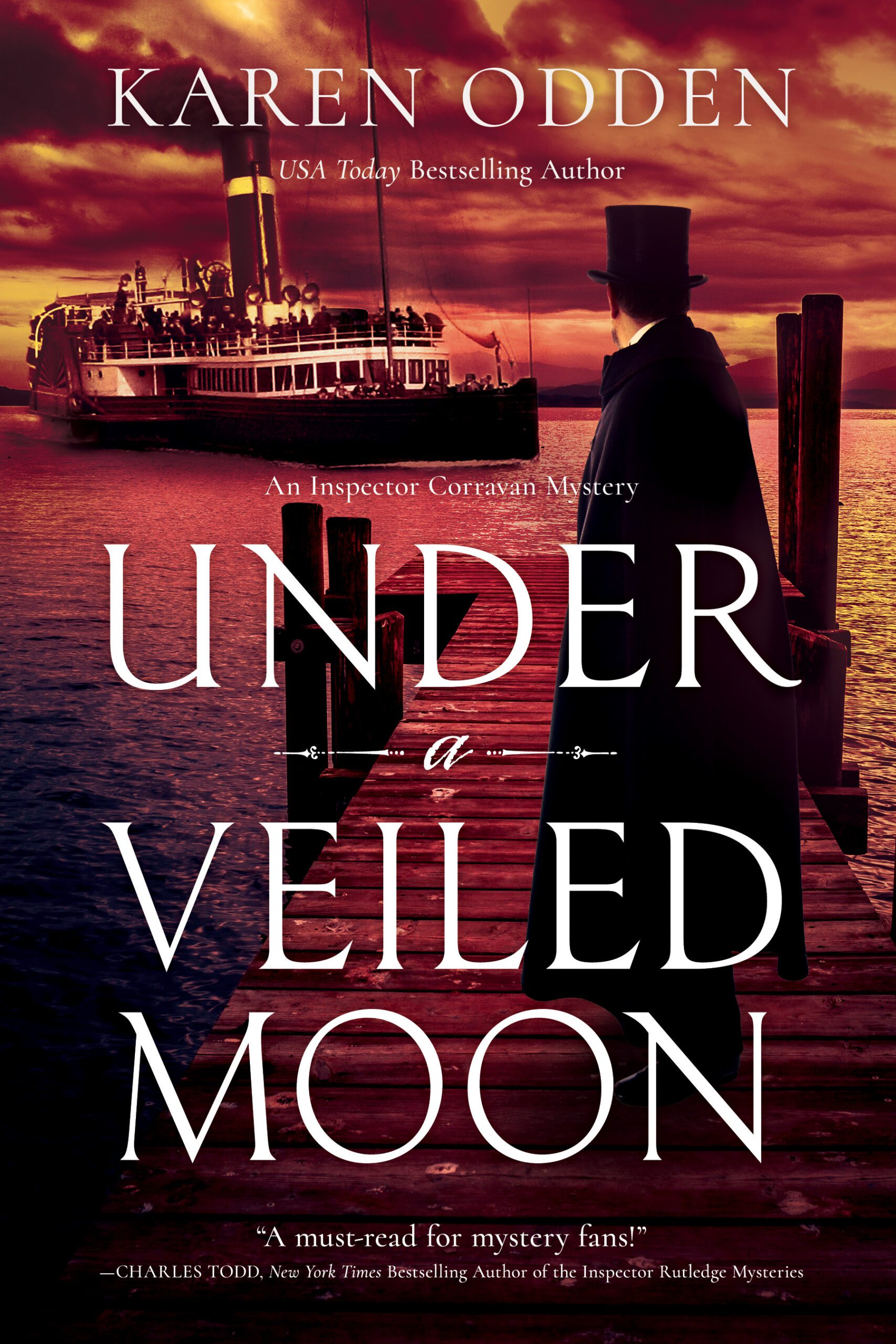
In the tradition of C. S. Harris and Anne Perry, a fatal disaster on the Thames and a roiling political conflict set the stage for Karen Odden’s second Inspector Corravan historical mystery.
September 1878. One night, as the pleasure boat the Princess Alice makes her daily trip up the Thames, she collides with the Bywell Castle, a huge iron-hulled collier. The Princess Alice shears apart, throwing all 600 passengers into the river; only 130 survive. It is the worst maritime disaster London has ever seen, and early clues point to sabotage by the Irish Republican Brotherhood, who believe violence is the path to restoring Irish Home Rule.
For Scotland Yard Inspector Michael Corravan, born in Ireland and adopted by the Irish Doyle family, the case presents a challenge. Accused by the Home Office of willfully disregarding the obvious conclusion, and berated by his Irish friends for bowing to prejudice, Corravan doggedly pursues the truth, knowing that if the Princess Alice disaster is pinned on the IRB, hopes for Home Rule could be dashed forever.
Corrovan’s dilemma is compounded by Colin, the youngest Doyle, who has joined James McCabe’s Irish gang. As violence in Whitechapel rises, Corravan strikes a deal with McCabe to get Colin out of harm’s way. But unbeknownst to Corravan, Colin bears longstanding resentments against his adopted brother and scorns his help.
As the newspapers link the IRB to further accidents, London threatens to devolve into terror and chaos. With the help of his young colleague, the loyal Mr. Stiles, and his friend Belinda Gale, Corravan uncovers the harrowing truth—one that will shake his faith in his countrymen, the law, and himself.
Praise for Under a Veiled Moon:
“[An] exceptional sequel … Odden never strikes a false note, and she combines a sympathetic lead with a twisty plot grounded in the British politics of the day and peopled with fully fleshed-out characters. Fans of Lyndsay Faye’s Gods of Gotham trilogy will be enthralled.”
Publishers Weekly, starred review
“Victorian skulduggery with a heaping side of Irish troubles.”
Kirkus Reviews
“Will keep readers curious and guessing to the end.”
Manhattan Book Review, 5-star review
“Damn fine historical crime fiction.”
Bolo Books
“Rich in emotion and historical detail, Under a Veiled Moon is a brilliant tale of the dark, thorny places where the personal and the political intertwine.”
Mariah Fredericks, Edgar award-nominated author of the Jane Prescott series
Book Details:
Genre: Historical Mystery
Published by: Crooked Lane Books
Publication Date: October 11, 2022
Number of Pages: 336
ISBN: 978-1639101191
Series: Inspector Corravan, #2
Book Links: Amazon | Barnes & Noble | Goodreads
Read an excerpt:
London September 1878
Chapter 1
We all carry pieces of our past with us. Sometimes they’re shiny and worthy as new half crowns in our pockets. Sometimes they’re bits of lint or scraps of paper shredded beyond use. Plenty of my memories carry a stab of regret or a burn of shame with them, and honestly, there are times when I wonder how we all bloody well live with the fool things we’ve done.
I’ve made a fair number of mistakes since I first donned a Metropolitan Police uniform in Lambeth, over twelve years ago now. Investigating murders and missing people isn’t a task for those who aren’t willing to go down the wrong alley three or four times before finding the proper one. But those errors are a result of making a poor guess based on limited knowledge, and while they may cause a few sleepless nights, they can be set aside.
The mistakes that feel less forgivable are those that hurt someone you love. Worse still is when you discover your error only years later. Often, there’s nothing to be done. Too much time has passed to make amends. And those mistakes—ach, it’s bloody difficult to forgive yourself when you should’ve known better, should’ve known to pick your head up and cast about to see what might happen as a result of your actions. Perhaps there’s no easy way to learn that lesson, other than failing to do it once and discovering later just what it cost.
Sometimes, during the evenings we’re together, my Belinda reads aloud from whatever book is occupying her at the moment. One night she related a Greek myth about a man whose wife was killed by a snakebite. By virtue of his music, he weaseled his way into the underworld and convinced the king of Hades to release her. The king had one condition, however, of the rescue: neither the man nor his wife could look backward as they were leaving. And what did the fool do? He turned back to be sure his wife was still with him. He couldn’t help himself, poor bloke. So the mouth of hell opened up, and she vanished forever.
But perhaps we can’t always help what we do in a moment of crushing fear.
When I was nineteen, scared out of my wits and fleeing Whitechapel with only a bag of clothes and a small pouch of coins Ma Doyle thrust into my hand, I didn’t look back. Unlike the man in the myth, I should have, though.
Perhaps then hell would not have opened up around me thirteen years later.
***
On the first day of September, I woke to pale autumn sunlight and a feeling of well-being. It didn’t happen often, and it took a few moments to recall the cause. I lay still, listening to the Sunday quiet of my house, to a lone costermonger’s wheels creaking and rumbling over the cobbles outside, and the bells from St. Barnabas’s tolling from the next street over. I no longer attended church, but I did believe in God—a reasonable and just God, although sometimes the world twisted justice around, like a boat line hitched badly around a metal cleat so it emerged from the knot in a direction you didn’t expect.
As I stared at the ceiling, I collected my thoughts with some satisfaction. I’d been acting superintendent at Wapping River Police for three months now, and we’d just resolved a case involving smugglers who’d been bribing Custom House men to underweight the scales, to avoid paying proper taxes. It had occupied my every breath for the past four weeks, and now I felt a sense of relief, like a weighted yoke off the back of my neck, as I always did when an important case ended. The newspapers had even printed something good about the police yesterday as a result. God knows we needed it. Sometimes I still cringed at the memories of the corruption trial last autumn, with mobs cursing us plainclothes men for being frauds and cheats, and newspaper headlines proclaiming how London would be better off if we were all at the bottom of the Thames. But with the river murders of last April resolved and this smuggling case concluded, it seemed the police were slowly earning back public trust. Of course, the stories published about our successes were full of inaccuracies, and by omitting any reference to the tiresome inquiries, the endless walking, and the misleading clues, they were nowhere near the whole truth, but at least they painted the police in a satisfactory light.
The door to Harry’s bedroom, next to mine, opened and closed, and as I heard the boy start down the stairs, I slid out of bed. The coals in my bedroom stove had burnt to ash, and the room was cool, with a dampness that lingered after a rainy August.
Standing at the window in my nightshirt, I looked across the way at the two-story red-brick terraced houses, built cheek by jowl, mirror images of those on my side of the street. The sunlight, golden as a well-baked loaf of bread, inched down from the roofline and struck the upper windows, flashing a shine that made me squint. It was a pleasure to think I had no plan for the day but to visit the Doyles for Sunday tea. What with the smugglers and my new responsibilities at Wapping, it had been over a month since I’d seen Ma, Elsie, and Colin—longer than I liked.
From downstairs came the sound of our kettle shrieking.
Harry would be preparing tea for himself and coffee for me. My brew was a holdover from the tastes of the previous century, I knew, but I couldn’t abide weak liquids in the morning. I’d taught Harry how to make my coffee properly after he said he’d do whatever necessary to keep me from growling at him.
Harry Lish had come to live with me here in Soho six months ago, after his father died, his mother having passed away years before. Harry was Ma Doyle’s nephew, but as she’d told me when he arrived at her house in Whitechapel, he didn’t belong there. His speech was too well schooled and his manners more Mayfair than Merseyside. Although barely sixteen, Harry was determined to study medicine, and I’d found a place for him at St. Anne’s Hospital with my friend James Everett, a physician and surgeon who supervised the ward for brain injuries and mental disorders. Harry was leaving the next day to spend a fortnight or so observing in an Edinburgh hospital, a special opportunity arranged by James, who found in Harry an eager and intuitive student.
I pulled on my shirt and a pair of trousers with the special side pocket for my truncheon, a vestige of my days in uniform. It being Sunday, I was off duty, but the Doyles lived in the heart of Whitechapel, and there was no point in being foolhardy. I splashed water on my face and ran a comb through my hair before stowing my truncheon and heading down the stairs.
“Good morning, Mickey,” Harry said as I entered the kitchen.
“Morning.” I accepted the cup he pushed across the table. The pocketbook he always took to the hospital lay beside his saucer. “Are you not coming with me to the Doyles’s?”
He winced an apology. “I would, but there’s a special procedure.”
“On a Sunday?”
He nodded, his brown eyes keen. “Dr. Everett is performing a craniotomy on a woman with blood on the brain.”
The coffee suddenly tasted sour. But far be it from me to dampen his scientific ardor.
“You’ll only be watching, I assume?” I asked.
Regret flickered over his features. “Observing from the balcony.” Then he brightened. “Richard will be assisting, though.”
Richard was a second-year medical student at University College here in London, who worked at the hospital and had taken Harry under his wing.
“How did it happen?” I asked. “Blood on the brain?”
“She fell off a ladder,” he replied. “If Dr. Everett doesn’t operate, the blood will continue to press on the internal parts and organs.” He touched his fingertips to the side of his head. “She’s already having secondary symptoms—seizures, confusion, and the like.”
“Ah. What time is it? The operation?”
He upended his cup to drink the last of the tea. “Ten o’clock, but I want to be there for the anesthesia.”
“Of course.” What could be more entertaining? I thought as I raised my own cup to hide my smile.
He reached for his coat. “Besides, I doubt Aunt Mary will expect me. I saw them on Tuesday. My aunt and Elsie, I should say,” he amended as he thrust his arm into a sleeve. “Colin was out somewhere . . . as usual.”
In his voice was an undertone—hurt, strained, subdued—that could have served as a signal of something amiss. But it was one of those moments when you must be paying proper attention to take it in, when you must be standing quite still. And we weren’t. Harry was dashing up the stairs, calling over his shoulder, “Wait for me—I’ll be right down,” and I was rummaging on the table amid some newspapers for my pocketbook—where was the bloody thing?—and the warning went unheeded.
I swallowed down the last of my coffee. Harry did well by me, leaving no grounds in the bottom, meticulous in a way that boded well for his success in a profession that demanded precision. With my pocketbook found, I shrugged into my coat, and when Harry reappeared on the stairs, his boots sounding quick on the treads, I waved him outside and locked the front door. We walked to the corner, where we bid farewell and separated. I watched him, hatless, his lanky boyish frame hurrying along, not wanting to miss the thrills to be found in the medical amphitheater.
I found myself grinning as I turned away, for I liked the lad, and we’d come to understand each other. Belinda says that in our both being orphans and clever, as well as in some of our less desirable traits such as our prickly aversion to owing anyone anything, we’re more alike than I’m willing to admit. There’s part of me that agrees with her, though Harry and I have our differences. Sometimes I wonder where I’d be if I’d had Harry’s book learning or someone overseeing my education and guiding my professional progress the way James does for Harry. Oh, my real mother had taught me to read before I lost her, and working at Ma Doyle’s store had made me quick at my sums. But every so often Harry would let slip a phrase in French or Latin, or he’d mention some curious bit of history, much the way James or my former partner Stiles does, not to show off his learning but just because it floats around in his brain. And I’d think about how we can’t be more than our past permits us.
Then again, my advancement within the Metropolitan Police has been my own doing. There’s some satisfaction in that too.
Chapter 2
It was a fine day for a walk, and I headed to my favorite pub— the only one within a mile of my house that served a satisfying wedge of shepherd’s pie in a proper crust. It was where I usually spent part of my Sunday, with the papers, and I knew the Doyles wouldn’t expect me before two or three at the earliest.
My favorite table was occupied by two men, but I chose another near the window where a newspaper was lying, its ruffled pages evidence of it having already been read at least once. I flipped it over to find the Times masthead and the bold headline “Sittingbourne Disaster,” with a drawing below it of a railway train with the engine, tender, and two cars tipped over on their sides and the usual chaos of people and their belongings flung from carriages.
I let out a groan.
Sittingbourne was fifty miles east of London, on the south side of the Thames, not far from where the river let out to the North Sea. I scanned the article, but there weren’t many facts provided other than it had happened the previous night, August 31, on the London, Chatham and Dover line, when an express train bringing trippers back from Sheerness and elsewhere had run off the rails. It seemed to be the result of either eroded ground or a rotted railway tie that destabilized the iron rail above it—the same problem that had caused the disaster at Morpeth last March, as well as half a dozen other accidents that had occurred around England in the past few years. Early reports indicated three dead and sixty-two injured, with numbers expected to increase. The article closed with the usual gloomy declarations about how, until railways are held to a standard of safety by Parliament, accidents such as this would continue to plague travelers.
I stood and went to another table, where I found a second paper whose account included the additional facts that, for some unknown reason, the railway train had been on the ancillary line instead of the primary line, approximately one hundred yards from the station; and five passengers, not three, had been killed. This version also included, on an inside page, lurid descriptions and illustrations of mangled bodies and children’s toys strewn among the broken carriages.
Those poor families, I thought. What a wretched ending to a pleasant excursion.
As I refolded the paper, worry nicked at my nerves. Belinda would be traveling home from Edinburgh by train in a few days. She’d been visiting her cousin for a month, which was the longest I’d gone without seeing her these three years since a burglary had first brought me to her home. The thought of her in a railway disaster carved a cold, hollow space in my chest.
But even as I imagined it, I dismissed my worry as nonsensical. Belinda had made this trip dozens of times, and the line from Edinburgh was one of the newest and safest. Besides, the newspaper’s pessimism notwithstanding, parliament had mandated new safety devices and procedures. No doubt this Sittingbourne disaster would require yet another Parliamentary Commission, and the Railways Inspection Department would be saddled with the task of providing weeks of testimony and filing endless reports. I didn’t envy them.
After finishing my pie, I took my time reading the remainder of the papers, then rose, shrugged into my coat, and left the pub, strolling east until I crossed Leman Street into Whitechapel. Many of the narrow, pocked streets were without signs, but I’d grown up among these crooked alleys, with buildings whose upper floors overhung the unpaved passages and oddly shaped courtyards, and I tacked left and right, left and right, until I reached the street with Ma Doyle’s shop. It always opened at one o’clock on Sundays, after Roman mass, and as I anticipated, there was the usual bustle around the door.
What I didn’t expect were the wooden planks that covered one of the windows.
Alarm pinched at the top of my spine and spread across my shoulders.
***
Excerpt from Under a Veiled Moon by Karen Odden. Copyright 2022 by Karen Odden. Reproduced with permission from Karen Odden. All rights reserved.
Author Bio:

Karen received her Ph.D. in English literature from New York University and subsequently taught at the University of Wisconsin-Milwaukee. She has published numerous essays and articles on Victorian literature, written introductions for Victorian novels in the Barnes and Noble Classics Series, and edited for the journal Victorian Literature and Culture. Her first novel, A Lady in the Smoke, was a USA Today bestseller and A Dangerous Duet and A Trace of Deceit have won awards for historical mystery and historical fiction. Her fourth mystery, Down a Dark River, introduced readers to Michael Corravan, a former thief and bare-knuckles boxer from Whitechapel who serves as an inspector at Scotland Yard in 1870s London. The sequel, Under a Veiled Moon, is available in hardcover, e-book, and audiobook. A member of Mystery Writers of America and a national board member for Sisters in Crime, Karen lives in Arizona with her family.
Catch Up With Karen Odden:
KarenOdden.com
Goodreads
BookBub – @KarenOdden
Instagram – @karen_m_odden
Twitter – @karen_odden
Facebook – @karen.odden
Tour Participants:
Tour Host Info:
Book Formats: ePub, Print
Hosting Options: Review, Interview, Guest Post, Showcase
Giveaway: There will be a tour-wide PICT Giveaway
More: According to the author Under a Veiled Moon does not include: Excessive Strong Language, Graphic Violence, Explicit Sexual Scenes, or Rape. Readers may encounter content that is considered to be a trigger situation. Generally the content is considered to be: Steamy Clean (mild language, mild sexual tension and innuendo, no sex scenes) content. At this time, PICT staff have not yet read this book and cannot give additional information.
Join In:
Thank you for your interest in this tour. We are no longer accepting hosts for Under a Veiled Moon. Please visit our open tours page to sign up for a current tour.