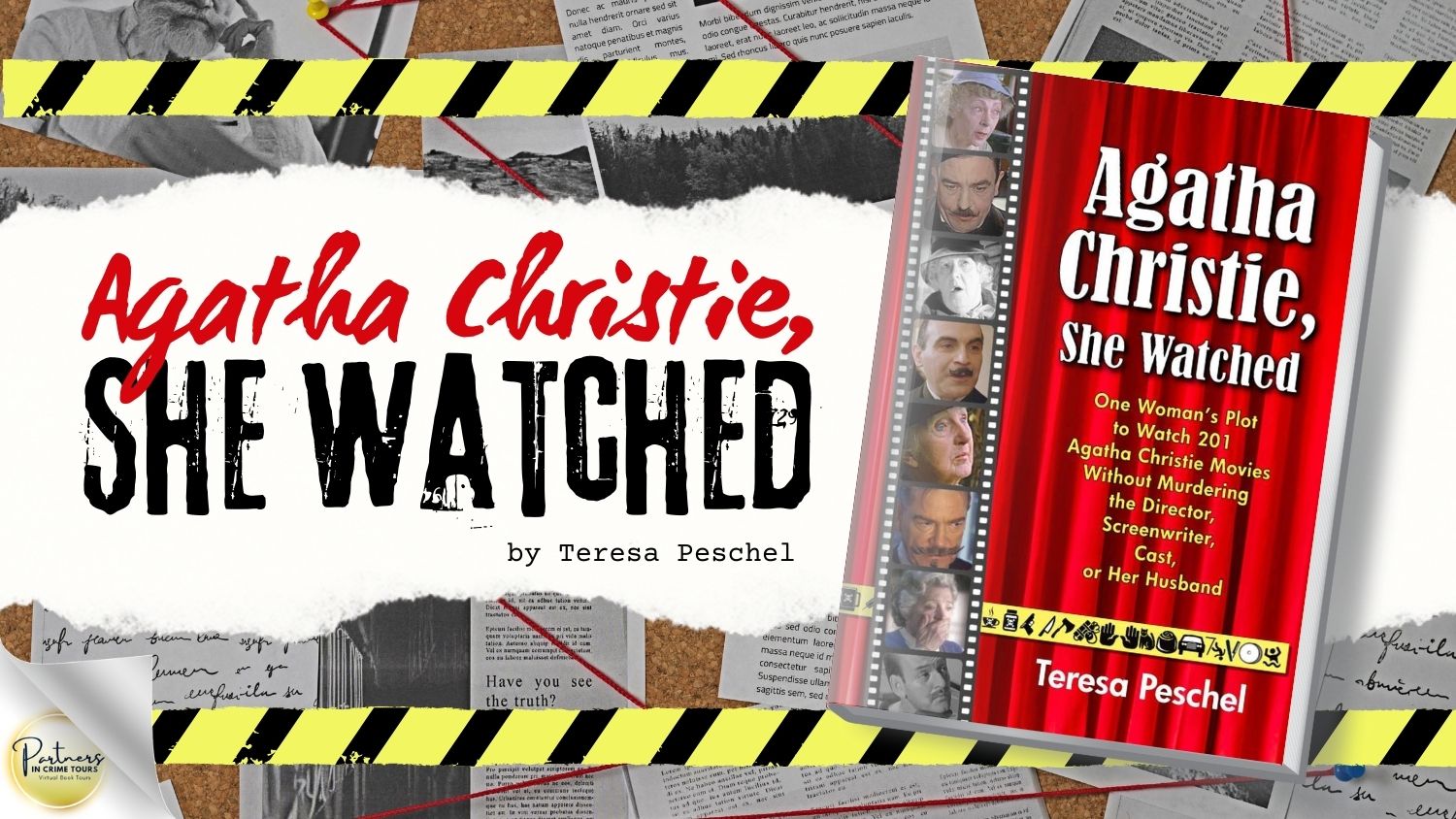
AGATHA CHRISTIE, SHE WATCHED
by Teresa Peschel
April 6 – May 15, 2026 Virtual Book Tour
Synopsis:
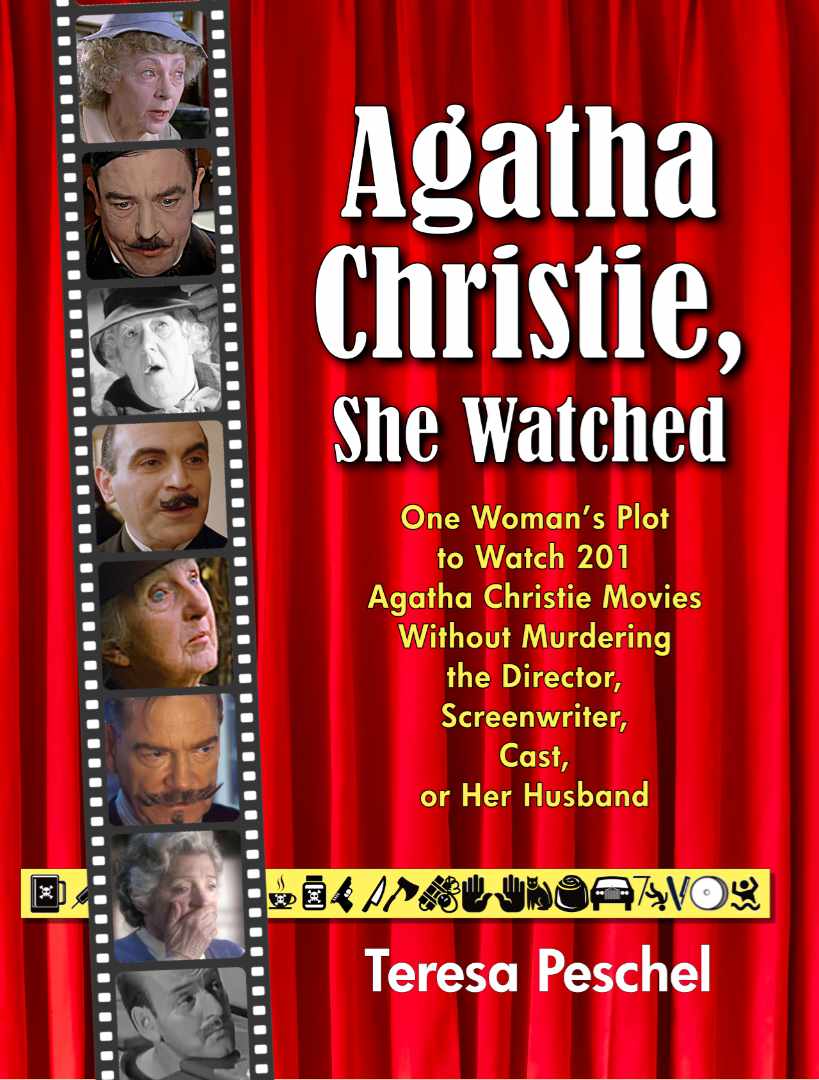
One Woman’s Plot to Watch 201 Christie Adaptations Without Murdering the Director, Screenwriter, Cast, or Her Husband
Care to match wits with Hercule Poirot? Share tea and gossip with Miss Marple? Chase spies with Tommy and Tuppence? “Agatha Christie, She Watched” will introduce you to must-see movies (and must-avoid) dogs that prove Agatha’s genius depicting the hopeful and dark sides of human nature. These movies will tantalize you, mystify you, and make you laugh at the folly of humanity.
Teresa Peschel watched and reviewed 201 adaptations, from the German silent movie “Adventures, Inc.” (1929) to “See How They Run” and “Why Didn’t They Ask Evans” (2022). Each film was rated for fidelity to the original material and its overall quality. Each review takes up two pages and comes with six cast photos, list of major actors, and known film locations. Foreign movies with English subtitles from India, France, Russia, and Japan are included. We include eight movies in which the fictional Agatha Christie solves murder mysteries, debates Poirot, battles a space wasp (in Doctor Who), and plots to kill her husband’s mistress.
“Agatha Christie, She Watched” is the only comprehensive collection of reviews about Christie adaptations. Use it to find the movies made from the novels you love, fill in your movie collection or host an Agatha Christie festival of your own.
Praise for Agatha Christie, She Watched:
“From the German silent movie Adventures, Inc. (1929) to Why Didn’t They Ask Evans? (2022), she covers all of your favourites (including the One True Poirot) and some you may never have heard of! The level of detail and vast array of images is incredible.”
~ Labours of Hercule podcast
AGATHA CHRISTIE, SHE WATCHED Trailer:
Book Details:
Genre: Movie & Video Reference, Movie & Video Guides & Reviews, Non-Fiction
Published by: Peschel Press
Publication Date: April 7, 2023
Number of Pages: 436 pages, Paperback
ISBN: 9781950347391 (ISBN10: 1950347397)
Book Links: Amazon | KindleUnlimited | Barnes & Noble | BookShop.org | Goodreads | BookBub | Peschel Press
Read an excerpt:
Introduction
I’ve always been a fan of Agatha Christie, but not an obsessive one. I didn’t read and reread the novels. I didn’t go looking for obscure short stories. I didn’t read (and still haven’t) her Mary Westmacott novels. I treated her like most people did: She wrote good mysteries, and if they were handy, I read them.
Then Bill began the Complete, Annotated project by publishing Dorothy L. Sayers’ Whose Body?, followed by Agatha’s The Mysterious Affair at Styles. Over the years, as he annotated the next five of Agatha’s early novels, I read them carefully for possible footnotes. As I did, I paid more attention to her writing, her deft plotting, her sly sense of humor, and her ability to describe a character with a few sentences.
As I became more familiar with her novels, I realized that she’s underrated, probably because she was categorized as a genre writer. Some even consider her works cozies. Clearly, they never read Appointment with Death (1938), And Then There Were None (1939), or Endless Night (1967). I suspect that her Mary Westmacotts — which are described as romances — are anything but.
The publishing world applies labels to make it easier for bookshops to shelve their books in the store, not because they’re accurate.
In July 2020, as the world began opening up from the Covid-19 shutdowns, I was at the library, looking for a DVD to borrow. I spotted Crooked House (2017). I liked the novel, so I thought, “Why not?”
Crooked House was the second Agatha Christie film adaptation I had seen. Sir Kenneth Branagh’s Murder on the Orient Express (2017) was the first.
We needed fodder for the website (peschelpress.com) and I’d already been reviewing books, so I wrote a review of Crooked House. This reminded me that Bill was working on an annotated edition of The Secret of Chimneys. Was there a movie version? A review for the book would be nice. There was. It was an episode in a box set from ITV’s Marple.
Oookaaaay.
Having become overly familiar with Chimneys, I knew Agatha wrote it years before Miss Marple was a twinkle in her eye. But we watched it anyway. It was terrible. Bill wrote his review for The Complete, Annotated Secret of Chimneys, and I wrote mine for the website.
Since the library’s Marple DVD set included three more episodes, we watched them and I reviewed them for the website.
That’s when Bill said the fateful words that brought us here: “Let’s watch more Agatha films. You write the reviews. I’ll post them on the website, and we’ll publish them as a book.”
So here we are nearly three years later. We had no idea how big the Agatha project would become or how many films have been made for cinema and TV. Bill and I have watched more than 200 adaptations. This includes all the English-language ones we could find beginning with Adventures, Inc. (a 1929 silent movie), and many of the foreign versions too. For those, we were limited by availability and whether or not they had English subtitles. It’s criminal neglect that some of the finest Agatha Christie film adaptations in the world are from Japan, yet they’re unavailable in the West.
To my knowledge, we are the only people who’ve watched all the films. I’m definitely the only person who’s written and posted reviews for all those forgotten TV shows and kinescopes.
Along the way, I became much, much more familiar with Agatha’s writing as I had to read the novels and short stories to compare them to the films. She was cutting edge from the beginning. She invented what we call The Poirot, the practice of bringing together the suspects, explaining the clues, and fingering the criminal. It was a trope born of necessity, when her first attempt — Poirot testifying at the trial — didn’t fly with her publisher.
She began experimenting with narrative structure in 1924 with The Man in the Brown Suit. That novel has two narrators, one of them unreliable. Brown Suit is also a romantic thriller disguised as a mystery. Read the passage where Anne Beddingfeld administers to a mysterious, half-naked, sexy stranger’s wounds. This scene could be ripped from any romance novel of today (the sweet kind, not the spicy which would include far more detail). As a side note, the 1989 TV movie is very true to the text despite being turned into a contemporary.
Agatha was an innovative writer throughout her career. Her The Seven Dials Mystery (1929) is a mash-up of P. G. Wodehouse and John Buchan thrillers. Partners in Crime (1929) is a loose cycle of 16 short stories starring Tommy and Tuppence. Each short story is also a parody of a famous mystery writer, including herself! And unlike Miss Marple and Hercule Poirot, Tommy and Tuppence aged in real time, from the young, eager lovers in The Secret Adversary (1922) to retired grandparents in Postern of Fate (1973).
And what’s And Then There Were None (1939), in which 10 characters are dispatched in an entertaining manner for their sins, but a PG-rated slasher flick? As a sign of its influence, the basic plot has been lifted, the serial numbers filed off, and rewritten in dozens more novels and movies. The A.B.C. Murders (1936) is a prototypical serial killer novel.
Agatha’s innovations could fill a book and go a long way to explaining why she’s still read today.
The other reason is more subtle.
Whatever you can say about the quality of the adaptations (like The Secret of Chimneys, bleah), they keep Agatha in the public eye. Never underestimate the importance of TV shows and movies on an author’s reputation. For each person who reads, 100 people go to the movies, and a 1,000 people watch TV. Every time an Agatha Christie film is shown, people who’ve never heard of her learn she exists. Some of them search out her books and discover how good her writing is.
When a writer dies, they can vanish under the constant tsunami of books being written and published daily. Dorothy L. Sayers is a prime example. Sayers wrote at the same time as Agatha. She’s highly regarded and her books are great. But her estate, unlike Agatha’s, shows no interest in licensing her stories and novels for TV or movies. Say the phrase: “Murder at Downton Abbey,” then ask why her literary estate isn’t capitalizing on Lord Peter Wimsey, detective in the peerage and a duke’s brother.
The Agatha Christie estate does not want her writing to suffer that fate, so they license her short stories and novels. Some adaptations are excellent; some are dreadful. For a few, the only commonality between novel and film is the name. Most range in between but all have something to offer, even if it’s only great period clothes, quality acting, or English Country House Porn. Linenfold paneling! Crenelated ceilings! Parquet floors as elaborate as the finest Persian carpet!
Excuse me while I stop and fan myself.
Watching 200+ Agatha adaptations also taught me plenty about filmmaking, pacing, and soundtracks. I can now, sometimes, recognize an actor from another adaptation. I’ve enjoyed seeing how one novel can be interpreted multiple ways, resulting in wildly different films. The Pale Horse (1961) is a good example. The three films (including Miss Marple in one!) are recognizably the same story, yet they’ve nothing to do with each other. The emphasis is different, the characters different, the tone is different.
I’ve watched 13 different Poirots (including an anime version). Seven different Marples (including an anime version). Multiple Tommy and Tuppences. Each actor or actress brings something new to the character.
The foreign films demonstrate how universal she is. She wrote about dysfunctional families, mapped the class divide, noticed the lengths we go to for status and security, and found reasons for murder ranging from money to passion to safety.
Ironically, foreign filmmakers respect Agatha more than she is at home. Appointment with Death (1938) has been filmed three times, but the Japanese version is the only one that captures the novel’s cruelty and horror. The two English language versions fail, one moderately and one spectacularly. Of the four versions of The Mirror Crack’d From Side to Side (1962), only the Japanese version gives a voice to Margo Bence, one of Agatha’s most abused secondary characters. The other three versions ignore her because to face Margo Bence’s pain would mean admitting that the film business cares nothing for children unless they can be sold to make money.
We did not watch every single foreign TV episode even when they were readily available. There just wasn’t enough time. The best we could do was see enough to convey the flavor of a given series. If you want to see them, enjoy yourself! They provide very different views of Agatha and can be rewarding.
The novel that’s been adapted the most is And Then There Were None (1939). We saw ten versions, ranging from a blurry kinescope to slick studio productions with an all-star cast, so it merits its own chapter. Some versions hew to the stage play with its radically rewritten ending. Others stick to the novel, nihilism intact. Some combine the stage play and the novel, so Vera Claythorne learns who the puppet master was, begs for her life, and receives rough justice.
One final warning before you go: spoilers abound, so beware! Unlike Agatha, I don’t play fair with my reviews and hide whodunnit. Where I play fair is in telling you what I thought of them. I liked films that critics panned, and I disliked films others loved. I say why. I go down sidetracks. I enjoyed myself and I hope you will too.
So won’t you join me for an Agatha Christie Movie Marathon? You’ve got hundreds of hours of viewing pleasure ahead of you. Just remember to never accept a cup of tea you didn’t make, or take trips to lonely islands (or châteaus, or country houses) with strangers.
How to use this book
The films are organized by the starring detective. Miss Marple comes first, followed by Poirot, and Tommy and Tuppence. Next, a chapter is devoted exclusively to And Then There Were None, followed by the rest of the adaptations, and the final chapter is movies in which Agatha herself is the star.
Each chapter opens with a photo gallery showing the actors and actresses who played her detectives and characters.
There’s also an index, which is more important than it appears.
Seems logical, yes? Except that some adaptations removed Agatha’s chosen detective, turning the novel into a police procedural. When that happens, the movie is not included in the detective’s chapter. It’s included in “The Rest of the Christies”. Many of the foreign adaptations fall into this category.
Other adaptations (cough, ITV’s Marple, cough) insert a detective who didn’t exist in the novel. That’s why many standalone novels appear in the Miss Marple chapter. She’s now the star of The Sittaford Mystery, Murder Is Easy, The Pale Horse, and others. She also appears in a Tommy and Tuppence novel, By the Pricking of My Thumbs. Similarly, Margaret Rutherford snatched two Poirot novels and made them her own, so they appear in the Miss Marple chapter.
The chapters dedicated to And Then There Were None and the movies not part of a detective series are self- evident. “Agatha the Star,” however, deserves an explanation. In addition to her stories, Agatha’s life has become fodder for Hollywood. This includes the dreadful Vanessa Redgrave/Dustin Hoffman biopic Agatha (1979), a documentary that quotes from her and her work, a Doctor Who episode, and three movies that show Agatha’s exciting life investigating mysteries in a parallel universe. It focuses on Agatha, not her writing. Any relationship to Agatha’s real life should be considered coincidental. Even the documentary in this chapter is not entirely reliable.
Within each chapter, the films are organized chronologically. As you move forward in time, you’ll see changes in how a character was depicted and movie-making styles. Adventures, Inc. (1929) sets the stage. It’s the earliest Agatha film and the scriptwriter, Jane Bess, played fast and loose with the text. She led the way for hack screenwriters everywhere to rewrite Agatha’s prose.
Each review gets two pages. We chose a banner image and six photos of important cast members. I rate films by fidelity to text (or life in “Agatha the Star,” and either the play or the novel in And Then There Were None) and by the quality of the movie overall. The two ratings are separate, but they complement each other and give you a clearer understanding of what to expect.
The cast lists place detectives and police at the top. Everyone else follows in rough order of importance. We group families together to make it easier to work out relationships. Our cast lists are not comprehensive but the main characters are there.
Also note that for those foreign films which don’t name their characters from the novel, we provide that information. This was omitted when they rewrote them so much (such as Unknown (1965), the Indian version of And Then There Were None) that it would not be helpful.
At the end of the list come the film locations, or (in a couple episodes) a song list. Internet Movie Database and Agatha Christie Wiki provided most of the locations, but Bill added to that from other sources (see the bibliography). Knowing the film locations means you, dear reader, can visit the same castle as Poirot or Miss Marple.
Subtitles matter to me. We always looked for versions with subtitles as so many actors mumble or the sound quality is bad. If I can’t understand the dialog, I miss important points. Not every DVD was released with subtitles.
Fortunately, some of the older films like the Joan Hickson Miss Marples are being cleaned up for streaming. They get subtitles. But they aren’t being released as new DVDs so, no subtitles. If you can watch a streamed version, no problem. If you must use your TV and DVD player, you’re out of luck.
We had to have subtitles for the foreign films. We couldn’t see some films we wanted to (we especially regret passing up the Japanese Murder on the Orient Express) because they either weren’t available with subtitles or they weren’t available at all.
The index will help you find a specific film. This isn’t just because some novels got Miss Marple inserted, putting them into the Miss Marple chapter. Agatha’s novels were often released under different names. For example, the novel Lord Edgware Dies (1933) was released in the U.S. as Thirteen At Dinner. It’s been filmed three times, twice as Lord Edgware Dies and once as Thirteen At Dinner. But they’re all based on the same novel and the index connects them.
I list all the names, with a note as to which film it applies to. Or, as with Margaret Rutherford, the film’s name doesn’t correspond to any edition of the novel but I tell you what to look for.
The bibliography provides further reading and shows where some of my information came from.
Enjoy the book. We enjoyed watching the movies, podcasting about many of them, and writing the reviews. We want it to be used, encouraging you to watch Agatha Christie on the screen, always different but always her.
How the movies are rated
Each movie is given two ratings. Fidelity of text is exactly what it sounds. How close is the film to the original text? Sometimes, only the names match. Other films are so faithful, they’re lifeless.
Quality of movie is about the movie itself. Did everything together work as a film? Often, a very good movie isn’t faithful to the text at all (see Miss Marple in Ordeal By Innocence (2007)). If something jars about the movie, I’ll indicate it here.
The rating icons demonstrate Agatha’s many, many ways of killing. Blunt objects, poisoned cocktails, garrotes, knives, guns, stranglers, being pushed down a flight of stairs. They usually reflect the first murder in the film.
A few films, such as And Then There Were None, get five different symbols to reflect all the ways those nasty people got iced.
How to find the movies
We watched the vast majority of the films on DVD on our TV set, the one our neighbors were throwing away. You’re correct that we count our pennies.
That’s why we use our public library. If yours is like ours, it contains a surprisingly large collection of Agatha Christie films. All you have to do is get a library card to borrow them.
You may, like us, have access to more than one library. It’s worth learning what’s available in your area. We belong to our local library (the Hershey Public Library) and to our county library (the much larger Dauphin County Public Library). They often carry different titles so I always check both before moving on to the next step.
Your library is bigger than your municipality, your county, or even your state. Ask for the interlibrary loan librarian. For us, it’s Denise Philips. Denise got us all kinds of DVDs from libraries across the country. This service is usually free, as libraries are tax-supported. Ask and you may be very pleased. The interlibrary loan may take a few weeks for the requested movie to arrive, but it nearly always will.
If Denise could not get us a title, Bill would search eBay and Amazon. We bought a universal DVD player so we could play DVDs from Europe.
There were obscure kinescopes that were on YouTube, so we watched them on the computer.
There are streaming services, including Amazon which gave us access to Britbox. Dailymotion let us watch the Japanese films.
We don’t recommend skeevy pirate sites. They’re illegal, don’t pay royalties to the creators, and whatever you get will be loaded with viruses and malware and the film may be incomplete or damaged.
*** A review ***
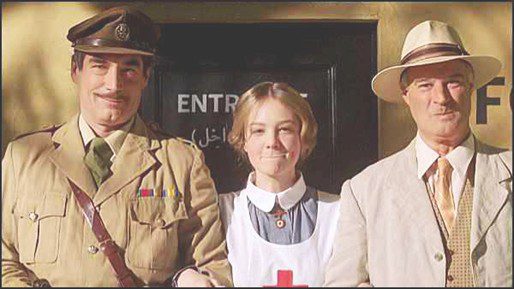
The Sittaford Mystery (2006)
The Sittaford Mystery (2006)
Epic expansion of Trevelyan’s life
leaves little room for a coherent
mystery for Miss Marple to sort out
Fidelity to text: 1 pharaoh’s curse

The novel was eviscerated. The murder, séance, escaped prisoner, and a few names remain. Everything else, including the murderer, were altered beyond recognition. Miss Marple resented being shoved in; she stayed defiantly offstage for long stretches.
Quality of movie: 1½ pharaoh’s curses

The scriptwriter shoved ten pounds of plot into a five-pound running length and the result is incoherence with snow.
The Review
Queue up Sir Mix-a-Lot and “Baby Got Back” and recite along with me:
Oh. My. God.
Look at that plot!
You’ll have to sit through this episode twice (at least) to understand what’s going on. This film is 93 minutes long, not long enough for all the disparate plot threads to be woven in a cohesive fashion. The film needed a minimum of another twenty minutes running time to do it justice.
But since ITV didn’t do that, you, dear viewer, will be left asking what just happened? Rewind, dammit! That’s what we did. Repeatedly. Yet there were many moments when I still can’t tell you what was going on.
The trouble starts with forcing Miss Marple into a property that was never written for her. This can work: see ITV’s By the Pricking of My Thumbs, a Tommy and Tuppence novel.
Not here. In fact, Miss Marple disappeared for long stretches of the film, doing heaven only knows what in Sittaford House while sitting out the blizzard. Maybe she was questioning the staff (we only see one servant in the mansion but there must be more), knitting, and speed-reading Captain Trevelyan’s memoirs. She certainly wasn’t at the Three Crowns Inn, inspecting the body and questioning the guests, even though most of the action takes place there.
An entirely new plot is shoehorned in, vastly expanding Captain Trevelyan’s character and backstory. Suddenly, he’s a war hero (WWI), a suspected war profiteer (WWII), an Olympic skater in between (I think; the dialog was incomprehensible at many key points), a major candidate to be the next prime minister (Winston Churchill (!) has a scene with Captain Trevelyan), and he’s a noted archeologist having discovered a major tomb in Egypt back in 1927 that made his fortune! Compared with Capt. Trevelyan, Indiana Jones was a lazy amateur.
But all this rewriting was necessary to give Timothy Dalton scenery to chew to earn his paycheck. In the novel, Captain Trevelyan exists to be swiftly murdered. He doesn’t even get one line. In the movie — since he’s Timothy Dalton — when he’s not emoting in front of us, he’s the topic of conversation by the other characters.
Which I can understand. It’s Timothy Dalton, and my goodness does he look yummy. Some men age very well and he belongs to that lucky cohort. He’s also got to be expensive so the producers made sure to get their money’s worth. Pity they didn’t spend some of their money on a better script or more film stock.
But he didn’t age that well. I had a hard time believing that virginal, lovely, dewy, eighteen-year-old Violet Willets (Carey Mulligan) fell madly in love with a man old enough to be her grandfather. I know why he did, and it’s not just because Violet resembles the woman he callously abandoned twenty-five years prior in Egypt. Violet is delicious, naïve, and believes every word he says and what man doesn’t want that? As for Violet, she didn’t come across as a gold-digger, which is the usual reason sweet 18-year-olds marry men old enough to be their grandfather. Or maybe she was one and the tacked-on ending where Violet runs off to Argentina with Emily Trefusis proves it.
Violet certainly wasn’t broken up about her husband being murdered on their wedding night. If anything, she seemed relieved. She got it all. The Trevelyan name, the inheritance, two tickets to Buenos Aires, and she didn’t have to sacrifice her sweet toothsome body to some old man, even if he was Timothy Dalton.
The Egyptian subplot was of major importance yet it didn’t make any sense. There was the paranormal aspect too, with a ghostly maiden showing up in Captain Trevelyan’s visions. Was there a curse on the gold scorpion? Was he going crazy? We’re never told. The ghost follows a different movie’s script when it appears and vanishes.
This script also doesn’t tell us how an Egyptian servant can show up in isolated Sittaford in 1949 and get hired on, no questions asked. I understand that the servant problem was bad enough that the upper crust didn’t ask as many questions as they could. But here? Really?
We know Captain Trevelyan did potentially bad things in Egypt. Yet he wasn’t suspicious when this mysterious Egyptian showed up at his door? He’d been having weird dreams about his past. He’s got a burgeoning political career which means close scrutiny of his private life. He’s supposed to be a smart man.
Add in the even more incoherent subplot about the escaped prisoner from Dartmoor prison. None of that made sense; not the purchase of the inn a year prior to the events of the story, not the backstory of how the star-crossed lovers met, not how the prisoner escaped from Dartmoor prison and found his way across the moors to be reunited with his paramour and cousin and their eventual escape to freedom.
There’s also the American war profiteer who helped Captain Trevelyan make a fortune manufacturing substandard munitions that killed more American sailors than the enemy. The American war profiteer’s personal aide-de-camp and quack doctor made even less sense. Why did the war profiteer need him around, other than as a dogsbody? There was mumbled dialog that sounded like they were both in the mafia, but it was unclear.
We also meet the incompetent government clerk who’s looking into Captain Trevelyan’s background to ensure nothing questionable is revealed to the press, thus discrediting the party. He’s not doing a very good job if Captain Trevelyan was a known associate of American war profiteers and he doesn’t know.
Then there’s Charles Burnaby. In the novel, he’s boy-reporter Charles Enderby. The name change was the first step in his complete reworking of motives and backstory. Yet we get no foreshadowing of his dramatic personal life or of his connections to the Trevelyan family.
We get almost nothing of James Pearson’s connection to Captain Trevelyan either. We get even less of a reason for Emily Trefusis to be engaged to James Pearson, boy alcoholic, other than that old standby: He’ll inherit big when Captain Trevelyan dies. Maybe that’s why Emily runs off to Argentina with Violet. She gets the money and the girl and doesn’t have to marry the boy alcoholic.
I could rant on, but you get the picture: This movie was a mess, barely suitable for Timothy Dalton fans. ITV could have saved the cost of his salary and paid for a better script. Or, they could have capitalized on Timothy Dalton and added another twenty minutes of movie, explaining all the subplots and how they connected.
General Information
Based on: The Sittaford Mystery (U.S. title: The Murder at Hazelmoor; novel, 1931)
Run time: 1 hr., 40 min. Subtitles: No
Writer: Stephen Churchett
Director: Paul Unwin
Cast
Geraldine McEwan as Miss Marple
Timothy Dalton as Clive Trevelyan
Mel Smith as John Enderby
Jeffery Kissoon as Ahmed Ghali
Laurence Fox as James Pearson
Zoe Telford as Emily Trefusis
James Murray as Charles Burnaby
Rita Tushingham as Miss Elizabeth Percehouse
Michael Brandon as Martin Zimmerman
Paul Kaye as Dr. Ambrose Burt
Patricia Hodge as Mrs. Evadne Willett
Carey Mulligan as Violet Willett
Matthew Kelly as Donald Garfield
James Wilby as Stanley Kirkwood
Robert Hardy as Winston Churchill
Film Locations
The Flower Pot Pub, Henley-on-Thames, Oxfordshire (pub exterior)
Dorney Court, Dorney, Buckinghamshire (Sittaford House interiors)
***
Excerpt from Agatha Christie, She Watched by Teresa Peschel. Copyright 2023 by Teresa Peschel. Reproduced with permission from Teresa Peschel. All rights reserved.
Author Bio:
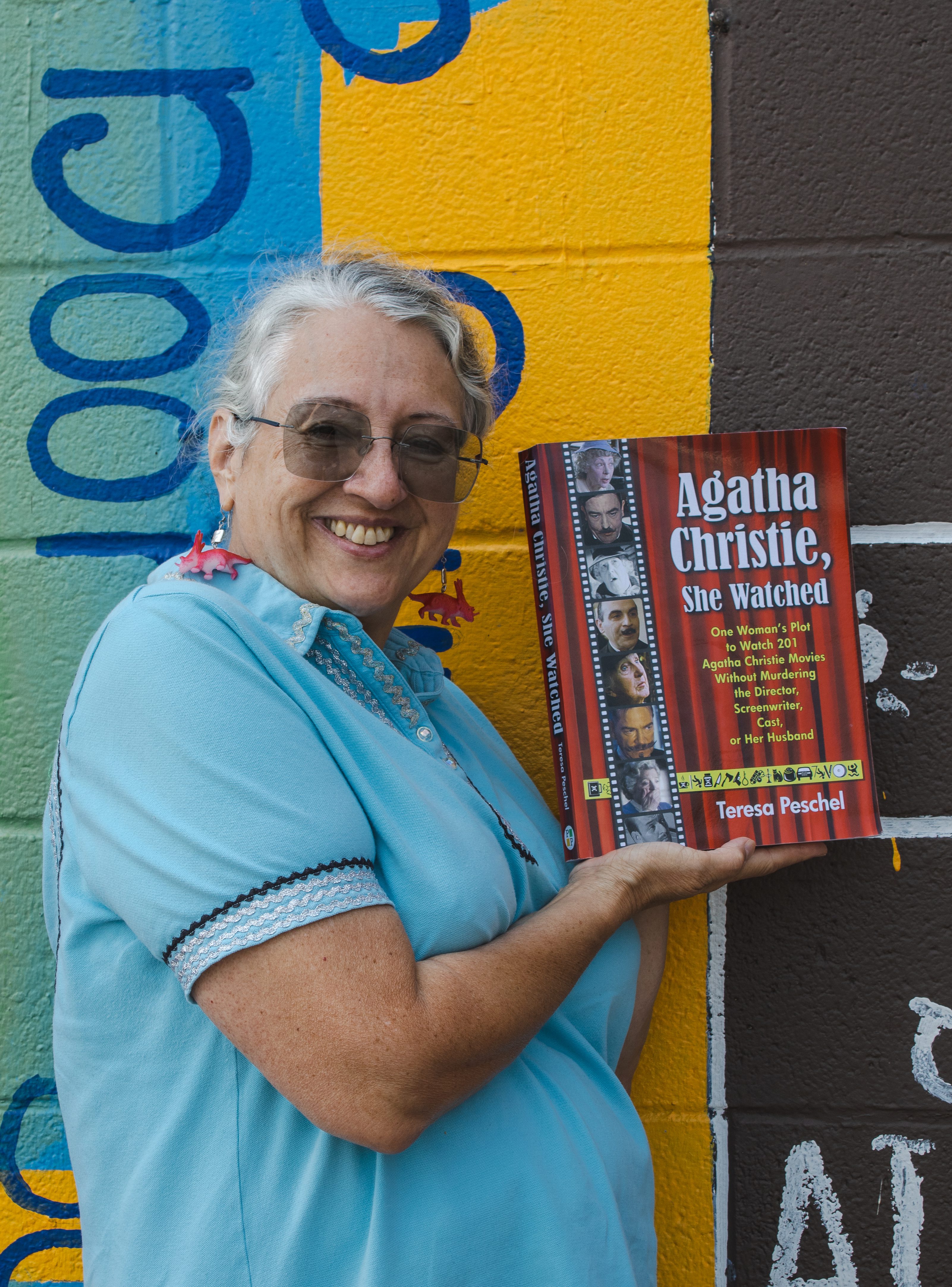
Teresa Peschel never planned to become a writer, nor did she plan to become an expert on film versions of Agatha Christie stories. Then, as a supportive wife, Teresa read and edited Bill’s annotations to Agatha’s first six novels. A desire to promote the books led to writing movie reviews for the Peschel Press website, which led to Bill suggesting they could publish a collection quickly. Two and a half years later, Agatha Christie, She Watched was born. This book got Teresa — and Bill as her supportive husband — an invitation to speak at the 2024 Agatha Christie festival in England.
Like Agatha Christie, Teresa reinvented herself and because of Agatha Christie, she’s become a better writer.
Catch Up With Teresa Peschel:
PeschelPress.com
Amazon Author Profile
Goodreads
BookBub – @peschel
Instagram – @peschel_press
YouTube – @peschelpress9911
X – @PeschelPress
Facebook – @PeschelPress
Tour Participant Reviews:
‘As a longtime fan of Agatha Christie, I found this book to be both fascinating and incredibly useful. What really makes the book shine is Peschel’s commentary. Her reviews are so witty, and funny. It’s clear this was a labour of love, and that passion comes through on every page.’
~ Bibliophile Foodie
‘If you are a lover of Agatha Christie’s work, then you need to run out and buy Agatha Christie, She Watched by Teresa Peschel. This well-thought-out guide is filled with black-and-white photos, fun rating icons, general information about each film adaptation, and the author’s insight into the actors, how a particular adaptation might compare to others, and more!’
~ The Book Connection
‘I found myself really interested in this one as I am a big fan of Agatha Christie books and movies as well. This is an excellent resource for any fan of Agatha Christie books or movies in my opinion.’
~ Country Mamas With Kids
‘I’ve read almost all of Agatha Christie’s books and have seen a fair amount of movie and TV adaptations. I am in awe of the author of this book who watched 201 Christie adaptations and did research on each for this book. This is an informative and entertaining book that I’ll be referring back to in the future as a viewing guide. Christie fans will love this book.’
~ cj_mo_2222
‘If you’re a fan of Agatha Christie or just love a good mystery, Agatha Christie, She Watched is a cracking read. Teresa Peschel dives into more adaptations than you’d think possible… and her reviews are full of wit and insight. Honestly, it made me want to binge-watch every adaptation and host my own Agatha Christie movie night.’
~ My Books and Crafts
‘This is a really fun book. Teresa’s balanced view and depth of experience make for great reading. Highly recommended.’
~ 5 Minutes for Books
‘Ever wish you had a Christie-loving friend sitting beside you, helping you decide which adaptations to watch next? I found myself laughing out loud as her personality came through on the page, and it honestly felt like she was right there on the couch with me as I built a whole new watchlist of Christie films and shows.’
~ Hott Books
‘Her detailed review of performances of Agatha Christie works is a must for any Christie fan. It will give you a guide to find the movie or TV program that will sate your thirst for mystery. I learned about so many shows that I wasn’t even aware existed.’
~ Words by Webb
‘This fantastic reference book is exactly my cup of tea. When I was a teenager, I devoured all the Agatha Christie books. My only problem with reading these books is that my To Be Watched list just got a lot bigger… when it comes to Christie adaptions you can also rely on “Agatha Christie, She Watched”.’
~ Storybook Lady
‘Billed as the only comprehensive guide to Agatha Christie movies, Agatha Christie, She Watched, is truly the only one needed. It provides everything you need to know to hunt down and enjoy the over 200 film adaptations of the world’s bestselling author’s works. With its amazing number of interesting facts, down-to-Earth commentary, and its comprehensive and very useful index, I highly recommend AGATHA CHRISTIE, SHE WATCHED to Agatha Christie fans wanting to experience the film adaptations of her works.’
~ Guatemala Paula Loves to Read
‘AGATHA CHRISTIE, SHE WATCHED is a delightful guide offering facts and commentary making it an invaluable resource of Agatha Christie films. The writing is smart, witty, and infinitely relatable. I chuckled as I was both entertained and educated. ‘
~ Cozy Up With Kathy
‘This is an absolute must for all fans of Agatha Christie! Teresa’s reviews are absolutely amazing and are so detailed and well-written. This is the fab accompaniment to enjoy any Agatha Christie adaptation. I already have this sitting in my living room ready to reference the next time I indulge in an Agatha Christie adaptation!’
~ Bookish Belfast Instagram
‘Get your popcorn & cozy blanket ready! If you’re an Agatha Christie fan, these companion movie guides are must reads! In Agatha Christie, She Watched, Teresa Peschel brilliantly delivers an organized, thoughtful, clever guide featuring movies from the 1920’s all the way up to 2022. If you’re new to Agatha Christie or a long time fan, this movie guide is a must have & a fun way to enjoy the many cinema adaptations of her wonderful mysteries.’
~ Melissa’s Bookshelf
‘This book will definately make you want to go out and start your own watch/review parties with your friends and family- I think Agatha would be rather bemused by that concept, and eager to join in!’
~ Bless Their Hearts Mom
‘This was a joyful gander through the world of Agatha Christie filmography – some I was familiar and some I was tickled to learn about for the first time. A good review method and an enjoyable time with Teresa Peschel’s thoughts on each. Worth it for Christie fans, but also those who want the skinny on the film versions.’
~ Books of my Heart
‘Agatha Christie, She Watched by Teresa Peschel is an outstandingly comprehensive book that any fan of Agatha Christie films will love to have. It is a must-have for Agatha Christie fans, and a fun way of enjoying her works via films.’
~ sudeshnablogs
‘What a wonderful way to delve into the world of Agatha Christie. If you’re a fan of Agatha Christie’s work, this book is a treasure trove! The handy index and extra resource pages at the back make it easy to navigate, ensuring you won’t miss a thing.’
~ Books Blog
Tour Host Info:
Book Formats: ePub, KindleUnlimited, Print
Hosting Options: Review, Interview, Guest Post, Showcase
Giveaway: There will be a tour-wide PICT Giveaway
More: According to the author Agatha Christie, She Watched does not include: Excessive Strong Language, Graphic Violence, Explicit Sexual Scenes, or Rape. However, readers may encounter content that is considered to be another trigger situation. Generally the content is considered to be no more than PG-rated content.
Join In:
Thank you for your interest in this tour. We are no longer accepting hosts for Agatha Christie, She Watched. Please visit our open tours page to sign up for a current tour.