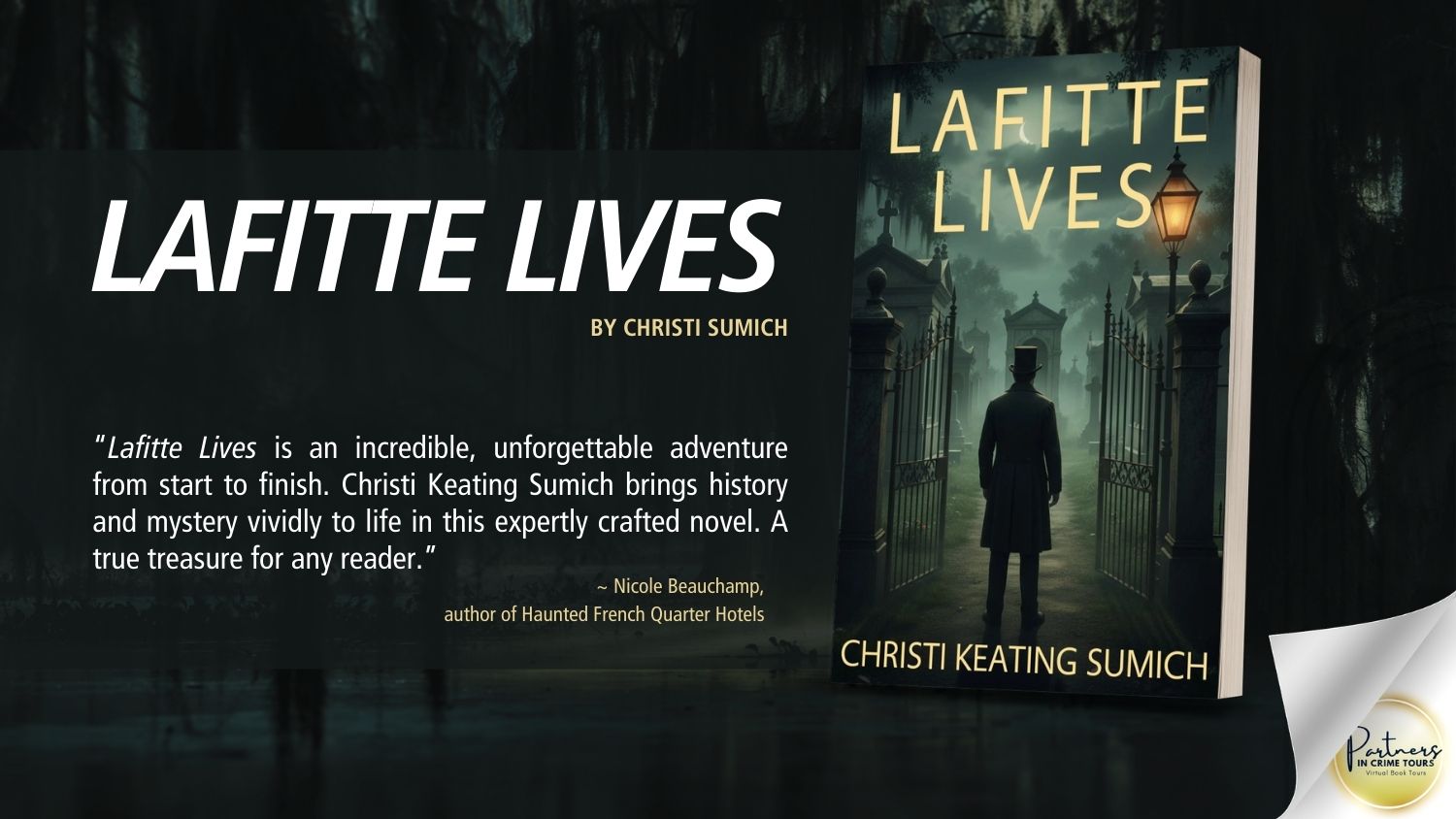
LAFITTE LIVES
by Christi Sumich
March 23 – May 1, 2026 Virtual Book Tour
Synopsis:
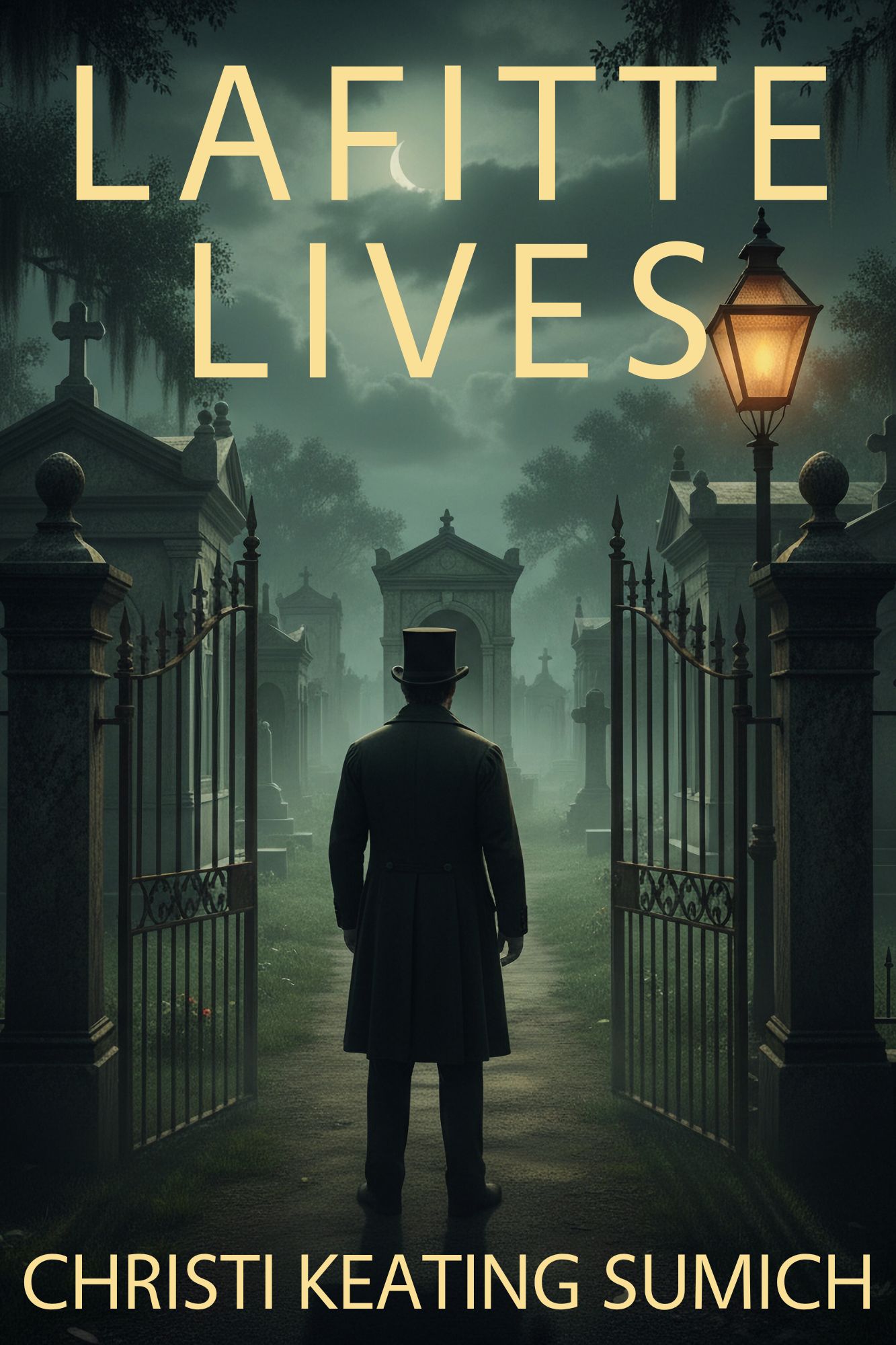
Secrets can’t stay buried forever—but maybe some should.
In bustling, multicultural 1831 New Orleans, Tobias Whitney, the sexton of St. Louis Cemetery No. 2, uncovers a journal sealed inside the tomb of Dominique You—war hero of the Battle of New Orleans, privateer, and half-brother of the notorious pirate Jean Lafitte. Convinced that the journal holds the key to Lafitte’s lost treasure, Tobias turns to his sharp-witted and outspoken wife, Mary Catherine, to translate its cryptic French passages.
Tobias and Mary Catherine discover secrets they could not have imagined—secrets that could change their lives forever. But is it really the truth? As the journal warns, Never trust a pirate!
Lafitte Lives blends meticulous historical research with a page-turning mystery, bringing the legend of Jean Lafitte to life while telling the redemptive story of Tobias’s grief and Mary Catherine’s quest to help him overcome it.
Praise for Lafitte Lives:
“Lafitte Lives is an incredible, unforgettable adventure from start to finish. Christi Keating Sumich brings history and mystery vividly to life in this expertly crafted novel. A true treasure for any reader.”
~ Nicole Beauchamp, author of Haunted French Quarter Hotels
“In August 1831, Tobias Whitney, Sexton—caretaker—of St. Louis Cemetery No. 2 in New Orleans, makes a startling discovery. Hidden in a hollow space in a mausoleum is the diary of Dominique You—half-brother of Jean Lafitte. The diary offers a first-hand account of Lafitte’s life after his reported death in 1823. As the title implies, Lafitte Lives. Find a comfortable seat, grab your favorite beverage, and let your imagination loose as Christi Keating Sumich delivers an engaging tale of the infamous pirate and patriot who may—or may not—have faded into the swamps and bayous of south Louisiana.”
~ Michael Rigg, Author of the New Orleans-based medicolegal thriller, Voices of the Elysian Fields
“Lafitte Lives is a ripping good pirate yarn surrounded by a touching story of family heartbreak and healing, all wrapped up in a tantalizing mystery. Steeped in rich period detail, it’s a tale filled with secrets and surprises readers won’t see coming. After all, never trust a pirate!”
~ J.R. Sanders, author of the Shamus Award winning Nate Ross series
Lafitte Lives Trailer:
Book Details:
Genre: Historical Mystery
Published by: Level Best Books
Publication Date: February 24, 2026
Number of Pages: 320
Book Links: Amazon | Kindle | Barnes & Noble | BookShop.org | Goodreads
Read an excerpt:
Chapter 1
New Orleans
August 1831
The worst part of the job was the smell. A decaying human body releases an oddly distinct scent. It is a horrid mixture of rotting eggs and cabbage, mothballs, feces, and an off-putting garlic-like odor, depending upon the gases released at each stage of decomposition. Being an observant sort of chap, Tobias Whitney was well-versed in the stink of human decay able to discern how far along a body was in the process of decomposition based on the particular aroma the tomb was emitting. It might be a cloying reek or a putrid stench. The time of year was a contributing factor. The hot, humid summer months were the worst. So much rotting flesh in one place combined to produce a nauseating medley of noxious aromas so foul that even Tobias, who spent his days in the cemetery, felt his stomach churn as he inhaled the soupy air.
Tobias had smelled foul odors before, of course. Anyone who lived in New Orleans long enough had. At this time of year, the privy behind his cottage was the stuff of nightmares. A body could get used to almost anything, though. Tobias had taught himself to focus instead on the delicate, honeyed scent of the flowering sweet olive bushes planted in the courtyards of homes all through the Vieux Carré, or the French Quarter as the Americans called it, for the express purpose of making the stench of so many privies in such close proximity more bearable.
Similar aforethought had gone into the landscaping at St. Louis Cemetery No. 2, where Tobias had been sexton for nearly three years. Unfortunately, the ethereal scent of fragrant flowering bushes and trees planted along the perimeter and throughout the cemetery grounds was far too subtle to mask the stink. It invaded his nose and marched its way down to his mouth. He let out a breath he’d been holding and put his sleeve against his nose as he inhaled. He spit to rid himself of the foul taste. Both actions proved futile. It was no wonder. The body interred within the tomb he was cleaning had been laid to rest less than a year before, and the tomb’s inhabitant to his right was an even fresher burial.
As sexton, he was responsible for maintaining the cemetery. Some months were busier than others, and August was keeping him at sixes and sevens, between all the yellow fever burials and the rains making a mess of the cemetery pathways. The cemetery had flooded recently, causing the crushed oyster-shell gravel to flow in rivulets between the above-ground tombs and collect in the lowest spot. Unfortunately, the lowest spot was the site of a recently built tomb.
The cemetery consisted mainly of above-ground tombs, whose care kept Tobias busy, though he remained fascinated by the structures. Above-ground burials were the custom here, in part due to the French and Spanish colonists who settled in New Orleans, and for more practical reasons. Guthrie Toups, the octogenarian and retired sexton whom Tobias replaced, had justified the tomb burials in the most colorful fashion.
“These tombs are your bosom friend.” He had waved his gnarled hand about, indicating the structures surrounding him, as he shuffled through the cemetery with Tobias on one of his final days on the job. “Smell like shite in summer but keep the floaters pinned down.” When Tobias failed to comment, Guthrie explained.
“Used to be, I worked at St. Peter Street Cemetery. All those souls went right in the ground. Two times I recall the rainwaters floodin’ the place somethin’ fierce. Coffins poppin’ up like gophers in springtime. Some washed down the street, right up to folks’ houses. When the lids came off, now that was a sight!” A shudder wracked Guthrie’s gaunt frame, rippling through his threadbare coat. “Took us weeks to round up the coffins. And then to find out who belonged where! Can’t put a body back in a hole when you don’t know who he is and which hole is his,” Guthrie shook his head. “Damn shame. You think lookin’ after these tombs is trouble until you gotta put coffins back whence they should never have been disturbed.”
Guthrie, who insisted on being called by his Christian name, had been gone from the cemetery for three years and from the world for two. Technically, he had never actually left St. Louis No. 2. He was enjoying his eternal rest, only one row of tombs over from where Tobias was currently toiling. Tobias considered whether Guthrie’s take on the tradeoff of floaters versus smell was valid. “Shite” seemed far too euphemistic a way to describe what was assailing his senses. Had the souls surrounding him been laid to rest underground, there would be no discernible odor, even in the August heat. However, in addition to being above ground, the vaults in St. Louis No. 2 were not airtight, a necessity since exposure to the elements ensured the bodies would decompose in a timely fashion. Following the bevy of recent rainstorms that Tobias’s wife referred to as “gully washers,” an additional component of stale, stagnant water added to the cemetery effluvium.
“God’s teeth!” declared Tobias in frustration, blowing out a breath of putrid air as he gazed at the dispersed gravel and mud piled up along the front and sides of the low-lying tomb. He continued raking, attempting to redistribute the mud-soaked mess along the paths that separated the tombs. It was slow going. The puddles of standing water made the task challenging, and, of course, another drenching rain would produce a similar mess. It was the sort of mindless labor that allowed a person time to think, though Tobias, as of late, preferred not to indulge his brain in aimless wandering. It inevitably led back to dark and painful places. Instead, he compensated by replacing his internal monologue with the voices of others, imagining how they might describe what he was presently seeing. It engaged his mind and allowed him to distance himself from his thoughts. He often remembered the tombs’ description, construction, and proper care, as Guthrie had first explained them to him. Even now, he could so vividly recall the old man’s gravelly voice, brittle as the oyster shells underfoot.
“Needed these tombs, the city did. So many coming to New Orleans after Jefferson bought her up, and so many dying here. Nowhere to put a cemetery unless you want to go digging graves in a swamp!” His guffaw had echoed off the tombs.
When Guthrie first began his tutelage, Tobias doubted that he could absorb any new information, so clogged was his brain with other thoughts. Still, the details distracted him. He yearned to learn all he could about the cemetery and the tombs where the bodies rested. He was fascinated, he feared morbidly so, with the amount of sadness one place could contain within its walls. Tobias could sense the pain and loss felt by the loved ones of St. Louis No. 2’s inhabitants, the heaviness of their collective grief threatening to crush him at times. He felt the familiar weight bearing down on him as he looked to his left, at the open tomb whose faceplate had been removed in anticipation of its next occupant, a newly deceased young woman who would be interred there tomorrow. The tomb was empty now, as she would be the first inhabitant.
He took a moment to wipe his brow and allowed himself to be transported back to the first time he had viewed an open tomb.
“‘Nother good thing ‘bout tombs is how many bodies you can stuff inside,” Guthrie had explained.
Tobias had to bend his lanky frame nearly horizontal to match the smaller man’s permanently hunched posture, but by doing so, he could peer into the yawning darkness of the tomb, the unnatural stillness of the space raising the hairs on the back of his neck.
“This one’s a single vault,” Guthrie said. “When the first one of the family dies, we put him in there, coffin an’ all. When the next one goes, that first one gets taken out of the coffin, and what remains of him gets put down in the caveau.” He motioned to the dark, far reaches of the tomb, beyond and below, where the coffin was to be placed. “And so it goes ‘til all the family is holed up in their tomb together. Here’s hopin’ they get along, cuz that’s some close quarters!” Guthrie punctuated this with a cackle and a bony elbow to Tobias’s ribs.
Guthrie’s litany of anecdotes and explanations encompassed nearly every inch of St. Louis No. 2, including the perimeter walls of the cemetery itself, comprised of stacked tombs that Guthrie had told him were called ovens.
“Cuz they look like ovens put one atop the other, and they heat up the bodies faster than cookin’ ‘em. That’s a good thing when you need to get a lot of bodies buried all at once.”
Guthrie’s mood had turned somber, the smile leaving his face. “I can remember stacking bodies up in ‘24 and ‘25 when Yellow Jack came for so many, and there was nary a place to put ‘em. Brought ‘em to the cemetery by the cartload and dumped ‘em right outside the cemetery gates, they did. Left those poor souls rotting in the sun, spreading their miasma over the city like a damned blanket. Least these ovens do the trick!”
The thought of yellow fever victims drew an involuntary shiver from Tobias, even this day, in the summer heat. Guthrie’s voice in Tobias’s head was sometimes the only company he had, not that he was complaining. Tobias craved solitude and was thankful to have this job. It paid a decent wage, enough for his family to live simply but comfortably, and perhaps best of all, it allowed him time to read.
He looked wistfully at his favorite reading bench, positioned in a particularly serene spot deep within the cemetery. The only sounds were the cooing of doves and the whining buzz of cicadas, so incessant this time of year as to become background noise. He felt the book’s weight in his pocket, ever-present and beckoning him to take a break. His vision blurred. He wiped the sweat from his forehead yet again to prevent more of it from dripping into his eyes. He yearned to lose himself, if only for an hour or so, in the all-absorbing action-adventure stories he loved so dearly. For the past few years, escaping from the world had become necessary for his survival. Strange, he often mused, that spending his days surrounded by the dead would be the only way he could cope with the living. Strange, but understandable, given what happened to him three years ago.
With a stubborn shake of his head, he said aloud, though no one else was around, “Not ‘til I put this tomb to rights.” Most families who owned vaults cared for them or paid the cemetery to perform the maintenance, which at the very least required replastering and whitewashing the brick from time to time. Even though the cemetery was relatively new, consecrated only eight years ago, he could already see the ravages the subtropical climate wreaked on those tombs without a caretaker to maintain them.
“Orphan tombs, these ones are,” Guthrie had said of the tombs left to crumble. “Got no livin’ kin to care for ‘em.” He had shaken his head, the wiry gray hairs swaying with the movement. “A whole family gone and no one to remember them.”
Tobias considered Guthrie’s words as worked this day. As he raked, he looked over his shoulder at one such orphan tomb and read aloud the inscriptions on the faceplate, “Constance Bulwark, born 1770, died 1824. Faithful wife, loving mother. ‘Blessed are the pure in heart, for they shall see God.’ Jeremiah Longstreet, born 1758, died 1827. Honest in labor, kind in spirit. May his soul rest in peace.” To preserve the dignity of the inhabitants within, he cleaned and made minor repairs to the orphan tombs, though it was technically beyond the purview of his duties. “You’ll not be forgotten,” he assured them before turning his attention to the task at hand.
The tomb before him was not an orphan, as the cemetery was contracted to maintain it, but it might as well have been. Its inhabitant had received no visitors since he was laid to rest. Still, this particular tomb had intrigued Tobias since its construction last November. Like most in St. Louis No. 2, it was brick. While not as extravagant as some tombs Tobias had seen, he found the elevated parapet facade aesthetically pleasing in a simple, elegant way. However, the feature that most fascinated him was the nameplate commemorating the occupant, Dominique You. You was a Freemason, as such, his tomb sported the square and compass symbol prominently carved into the top of the marble nameplate. Below the name was an inscription in French. Tobias was Irish and could not discern the writing, but he knew from the accounts he had read in the papers that the inscription was from Voltaire’s La Henriade:
Intrepid warrior on land and sea
in a hundred combats showed his valor.
This new Bayard without reproach or fear
Could have witnessed the ending of the world without trembling.
Dominique You was an infamous privateer and, some say, the half-brother of the notorious pirate Jean Lafitte. Tobias had read all about the adventures of the two buccaneer brothers in the weekly broadsheets he purchased. Lafitte had been killed in 1823, the same year St. Louis No. 2 opened. But while Lafitte’s whereabouts in the years before his death remained a mystery, Dominique You had lived out his final years in New Orleans, keeping a tavern and serving on the city council. He may have been a privateer, but he was also a war hero, having served valiantly as a gunner in the Battle of New Orleans, warding off a British invasion of the city by commanding a company of artillery composed of fellow pirates.
Stories about Dominique You and Jean Lafitte were legendary around New Orleans and made the adventure novels Tobias read pale in comparison. Tobias vividly recalled his excitement when Dominique You was buried right in front of where he was now standing. Although You died in a state of penury, the people of New Orleans did not forget his heroism. He was given a lavish funeral at the Cathedral of St. Louis, with full military honors, the likes of which the city had seldom seen. Throngs of mourners had followed the coffin to the cemetery. As the sexton, Tobias had been there to witness it all.
Many brought flowers to lay on his tomb, chrysanthemums or early-blooming camellias. Others brought magnolia leaves, fashioned into wreaths or dried herbs tied into bouquets with bits of ribbon or string. There were also rosaries, little vials of holy water, candles, and voodoo tokens left on You’s tomb. The mourners were as varied as the offerings they brought, well-dressed gentlefolk alongside the more common sort. They were all here for the same reason: to pay their respects to the man who helped save the city from the British fifteen years before.
Tobias had caught snippets of conversations all around the tomb. One, in particular, stayed with him. A group of rough-looking men, ill at ease in their mourning attire, had gathered at You’s tomb.
One of the men said, “Sailed with him, I did. No finer man you’d want at your side when things turned hairy. I’d trust him with my life.”
“As would I,” his mate agreed. “Fought beside him, too. Best cannoneer I ever saw. That’s why the general said he’d storm the gates of hell with Dominique as his lieutenant!”
Tobias had been particularly impressed with this, considering General Andrew Jackson was now president of the United States. He watched as they poured a slug of rum next to the tomb. It soaked into the gravel, leaving the scent of molasses and cloves lingering in the air like a final tribute. Tobias wondered with a shudder if these men were pirates themselves.
He’d had little time to dwell on it, as a Mason engaged him in conversation shortly after Tobias overheard this exchange. The man donned a fine wool suit, well cut and fashionable, with a frock coat that gracefully skimmed the back of the knees of his trousers. Tobias usually donned a working man’s attire for his days in the cemetery, loose-fitting tweed trousers and a jacket, although on this day, he donned a suit. It was one he used to wear as a shop owner before he became a cemetery sexton, though now he donned it only for Sunday Mass. His wife, Mary Catherine, would have his hide if he showed up to work on the day of an interment of such prominence in anything less. Tobias felt rather nattily clad until he beheld the sartorial superiority of the man. Despite their difference in clothing, the Freemason was eager to engage Tobias in conversation, and Tobias found this agreeable.
Funny how he spoke to almost no one these days, save his family and his close friend, the proprietor of his beloved bookshop, Chapter and Verse. Yet within the walls of the cemetery, he came back to life, if only for a short time. He felt at home here as much as he did in his cottage on Bienville Street. Though he knew precisely why this was, he found it a disconcerting aspect of his personality that he was more comfortable with mourners than with those unaffected by death.
“Not a business in New Orleans stayed open today. Everyone’s here to pay their respects,” the man told Tobias. “I suppose you heard the cannons fired for him?”
Tobias assured him that he had, and added that he’d also noticed the flags flown at half-mast.
The Mason nodded.
“He was a proud man, Dominique You.” The man seemed uneasy in the cemetery, as Tobias found most people to be. He suspected the Mason’s attempts to converse stemmed from a compelling need to fill the silence. Tobias noticed the man’s unconscious fidgeting with the intricately designed collar that nestled just below the tie on his starched white linen shirt, the adornment an indicator of his status among the Brotherhood. He spoke with a French accent, and his eyes told the story of a man who accepted the inevitable tribulations of life while still finding joy in living. Tobias was immediately envious of him.
“Had not a penny to his name at the end but did not tell a soul of his troubles.” The man gazed wistfully at Dominique’s tomb.
Tobias would have left him to his thoughts, but he continued. “We would have come to his aid, I can assure you of that. But Dominique was never one for charity. Tough old sailors rarely are. At least we could honor him in this way.” With a tip of his top hat by his white-gloved hand, the man moved on, presumably finding Tobias too taciturn.
Yet for all the military fanfare and grandeur surrounding the funeral, now, a mere nine months later, the tomb lay quiet. Tobias had seen no visitors at the tomb since that day. Dominique You had never married, and although he had been a rather upstanding citizen in the twilight of his life, he did not appear to have close friends, at least not that Tobias had seen. Close friends visited a grave from time to time, but not even his brothers from the Masonic lodge had come. And those had been the folks most upset by his death, at least if public grieving was any indication. Then again, Tobias had seen a lot of grief in his tenure at the cemetery, and it had been his observation that even members of the sterner sex could make an enormous fuss over the coffin and then never come back.
The people who looked the most distraught, as if they did not care to go on living, usually got over it by morning. It was the ones who never took their eyes off the coffin, even as it made its way into the vault, that you could be sure would put flowers there for years. Real grief was mostly invisible. It consumed a person from within, leaving only an outer shell that appeared to the world as a whole being, but was hollow inside. Tobias ought to know. He recognized it in others because he was just a shell himself.
Tobias wondered once again why the Freemasons had chosen this spot for You’s tomb. It seemed a poor location in the cemetery to build a tomb, but it was not Tobias’s place to say so. It was kind of the Freemasons to construct it for their brother, even if they had decreed it was to be sold in fifty years. This stipulation did not surprise him, as he knew people sometimes purchased tombs this way. The odd part to him was that an entire tomb would be dedicated to only one person when many held multiple family members.
Tobias would have thought a single man with no surviving family, and one who did not have much money, would not need a whole tomb to himself. But perhaps his contribution as a war hero had moved some hearts to loosen their purse strings and fund this stand-alone vault. This was a monument to Captain Dominique You, and Tobias would do his part to honor his memory by mucking out the mess around the man’s final resting place.
He finished raking the gravel around the front, repositioning it as best he could amid the puddles that stubbornly lingered even with the scorching August sun. Now he moved to the side of the tomb, where the ground was slightly lower, causing even more water to pool. He could not do much else until the water drained, which might take a while in New Orleans. In the meantime, he could wipe away some of the mud that had splashed onto the tomb from the rainstorm. He pulled a clean rag out of his pocket and decided to concentrate on the nameplate on the front of the tomb.
It was then that Tobias noticed the oddest thing—the marble plate was not flush against the bricks. Tobias chided himself for not observing this before, but as he studied it closely, he realized that it appeared to be placed properly from the front. It was not until he looked from the side that he could see the marble stone was bowing. This was indeed curious, as he himself had placed the outer tablet. As sexton, it was part of his duties to affix the plate upon the bricks after the body was interred and the tomb bricked up.
He had seen marble bow when exposed to extreme heat, but thick nameplates typically did not deform so quickly. It was a blessing in disguise that the rain, which would inevitably flood the cemetery in the summer months, had necessitated him spending time around this tomb, allowing him to observe it more closely. Had the Freemasons chosen a more optimal spot to place the tomb, it might have been many years before he had noticed this subpar workmanship. And since the inhabitant had no living family members, it might not have been until the fifty years were up and the sexton opened the tomb for a new burial that the faulty nameplate was discovered.
But surely, he would have noticed if something was amiss with the marble. He leaned in for a closer inspection and blinked rapidly. He thought perhaps it was a trick of the bright sunshine, but as he stared at the marble slab, he discerned a hairline fracture running the length of the stone. Dominique had been interred less than a year ago. This nameplate should not display such signs of degradation. Had he somehow damaged the stone when bolting the nameplate onto the brick vault? Utterly perplexed, Tobias pondered what he should do. He was exceedingly curious whether his workmanship was to blame for the bowing and cracking or if it was a defect in the stone itself.
He knew he should probably wait until he had help, but his inquisitive nature got the best of him, and he rushed off to retrieve his wrench. Removing the large bolts holding the nameplate in place would not be an easy job to perform by himself. He half-expected that he would not be able to loosen them at all, but was relieved and more than a bit surprised to find them coming loose without even having to apply heat. He knew the stone would be too heavy to maneuver on his own, but he planned to slide it down to the ground once it was free from the brick on the front of the vault. With less effort than should have been required for such an undertaking, Tobias freed the marble slab and eased it down about a foot until it rested upright against the tomb. To conduct a proper inspection, he would need to see the back of the slab. The stone was indeed heavy and should have been cumbersome for two men to handle, yet Tobias was able, with some difficulty, to lay the slab on the ground so that the back was visible.
He instantly understood why he was able to maneuver it unassisted. The back of the marble had been carved out, and the stone, too thin in the center to withstand the intense heat, had bowed as a result. The thinned-out stone also accounted for the hairline fracture Tobias had noticed. This nameplate was not the solid, thick slab he had affixed to Dominique’s vault nine months ago. The slab had been altered and reattached, unbeknownst to him. Tobias did not need to ponder why someone had done this because nestled within the carved-out space was a book.
***
Excerpt from Lafitte Lives by Christi Sumich. Copyright 2026 by Christi Sumich. Reproduced with permission from Christi Sumich. All rights reserved.
Author Bio:

Christi Keating Sumich holds a PhD in history from Tulane University and a master’s degree in English. Her research field is seventeenth-century disease and healing.
Christi’s writing combines her fascination with history with her love of the mystery genre. Her debut novel, Lafitte Lives (Level Best Books, March 2026), is a historical mystery centered on her ancestor, the notorious pirate Jean Lafitte. She is also the author of the Old New Orleans Bookshop Series, mysteries featuring characters from Lafitte Lives. The Swamp Ghost is the first book in the series (Level Best Books, September 2026).
Christi is also part of a writing team with her mother, Sharon Keating. They are the co-authors of Hauntingly Good Spirits: New Orleans Cocktails to Die For (Wellfleet Press, 2024) and The Brandy Milk Punch (Louisiana State University Press, 2025), part of the Iconic New Orleans Cocktail Series.
Catch Up With Christi Sumich:
ChristiSumich.com
Amazon Author Profile
Goodreads
BookBub
Instagram – @casumich
Facebook – @christi.keating.sumich.author
Tour Participants:
Tour Host Info:
Book Formats: ePub, Print
Hosting Options: Review, Interview, Guest Post, Showcase
Giveaway: There will be a tour-wide PICT Giveaway
More: According to the author LAFITTE LIVES is considered to be PG-level content or less. Readers may still encounter potentially sensitive material. If you have specific trigger or content concerns, please contact Partners in Crime Tours directly for more detailed information.