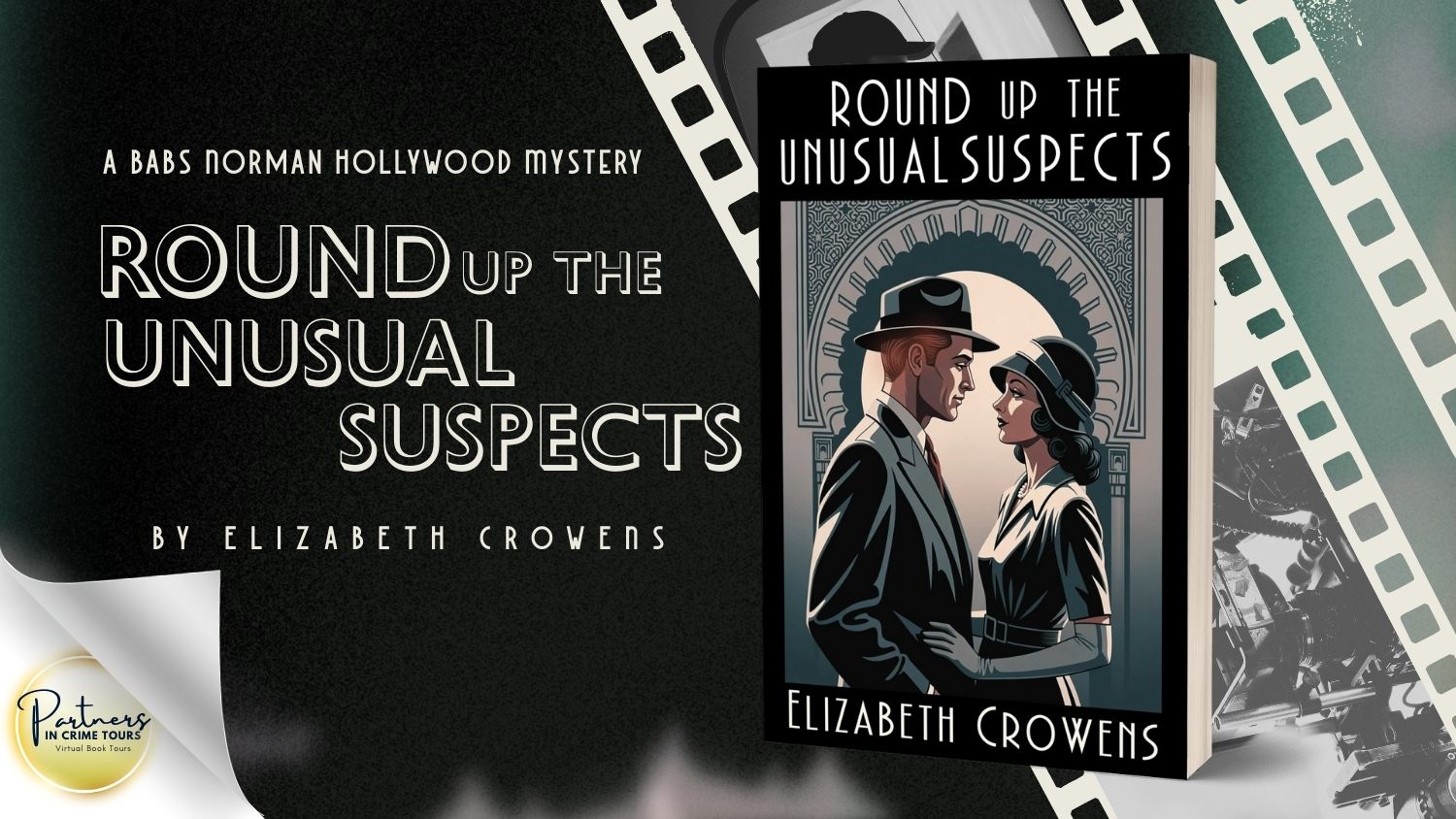
ROUND UP THE UNUSUAL SUSPECTS
by Elizabeth Crowens
March 9 – April 17, 2026 Virtual Book Tour
Synopsis:
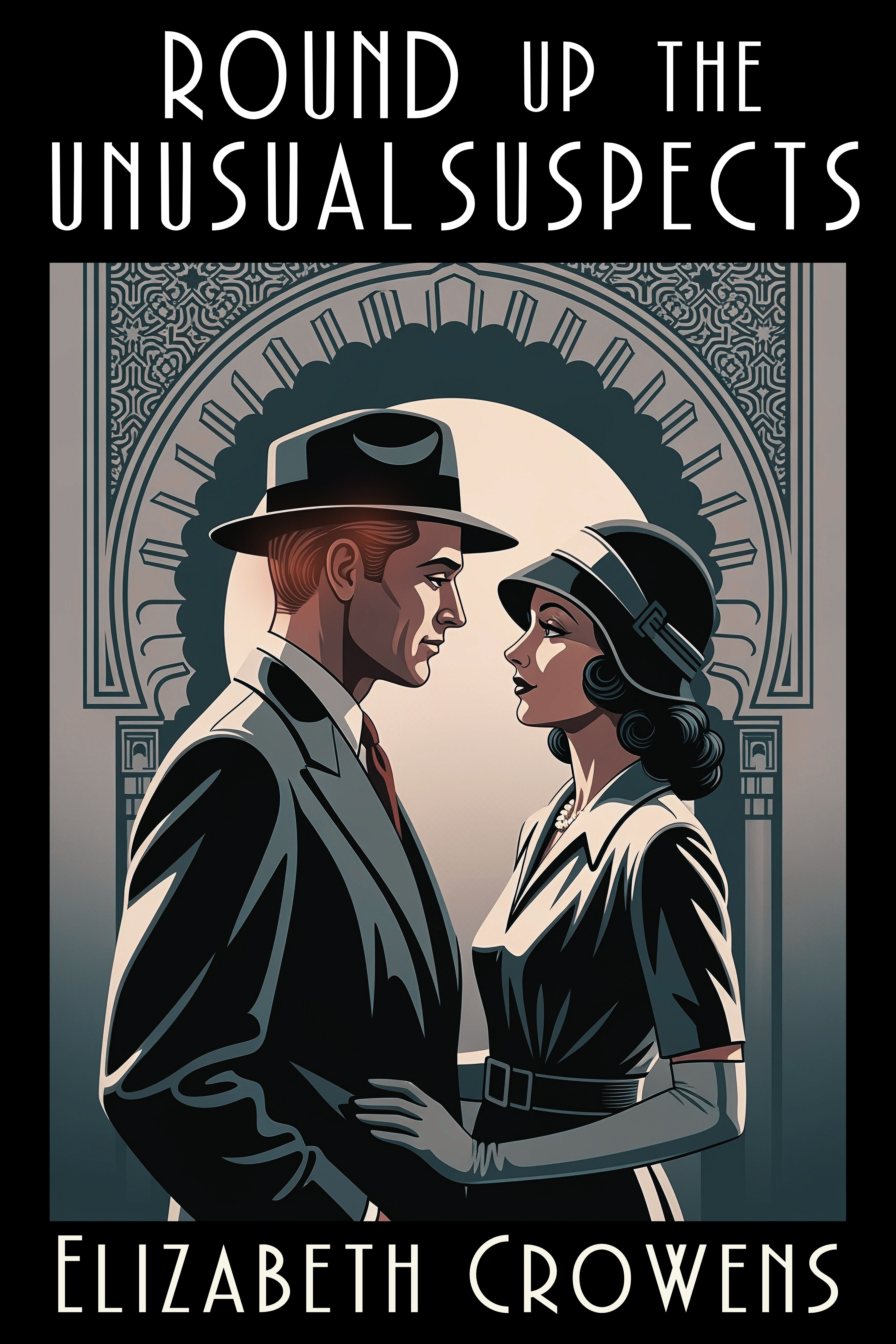
A Babs Norman Hollywood Mystery
Against the backdrop of WWII, no one expected to find a murdered stagehand on a Warner Brothers sound stage. With so much at stake, Jack L. Warner hires Babs Norman and Guy Brandt, the two young private eyes who recently resolved his high-profile Maltese Falcon/Blackbird Killer Case. Social justice crusader Leon Lewis suspects local Nazi sympathizers are responsible. Lewis assigns a German stuntman, a veteran of the decadent subculture of Weimar Berlin nightlife and one of his newest operatives, to join forces with the private detectives.
According to Warner, the show must go on, but everything from bomb scares to the Japanese internment, to unruly parrots, forbidden love, and family crises conspires against solving the crime. “As Time Goes By,” actors Humphrey Bogart, Ingrid Bergman, and the rest of the Casablanca ensemble join the professional private eyes to round up the unusual suspects and capture the killer.
Love 1940s classic movies? Treat yourself to the award-winning Hounds of the Hollywood Baskervilles (Book 1) and Bye, Bye Blackbird (Book 2) of Elizabeth Crowens’ Babs Norman’s Golden Age of Hollywood mystery series by Level Best Books.
Round Up the Unusual Suspects Trailer:
Book Details:
Genre: Golden Age of Hollywood Mystery with humor
Published by: Level Best Books
Publication Date: January 20, 2026
Number of Pages: 328
ISBN: 979-8-89820-189-0 (paperback)
Series: A Babs Norman Hollywood Mystery, Book 3 || Amazon, Goodreads
Book Links: Amazon | Kindle | Barnes & Noble | BookShop.org | Goodreads | BookBub
Mystery Series
 Amazon | Kindle | Barnes & Noble | Goodreads | BookBub |
 Amazon | Kindle | Barnes & Noble | Goodreads | BookBub |
Read an excerpt from Round Up the Unusual Suspects:
Chapter One
“Nobody’s allowed to die on one of my sets!” hollered Jack L. Warner. “Who’s the jackass who wants to halt my production?”
Flanked by his personal assistant Bill Schaefer, Jack dragged Hal B. Wallis, his head of production, over to the sound stage filming Yankee Doodle Dandy, starring James Cagney. He swung open the door as soon as the red warning light turned off and stormed inside.
Michael Curtiz, the film’s director, dumped his megaphone and threw down the gauntlet. The parade band on stage accompanied his rage with a drumroll and cymbals.
Warner nabbed Curtiz’s discarded megaphone. “Rally the troops—all of them! I have a studio-wide announcement.”
Curtiz, turning red, clamped his hands over his ears. The actors and background extras, dressed in woolen military uniforms, stopped marching and sweltered under the hot lights. The live orchestra fell silent.
“Sir, maybe we should check out the dead body first,” Schaefer suggested with hesitation.
At Warner’s command, an assistant rolled back a piece of movable scenery to reveal a prone figure, an unknown young man wearing bloodied street clothes, but with a swastika carved on his neck.
“Are you sure he’s dead?” Warner asked. “He looks like he’s just sleeping on the job.”
Backing up a few steps, Wallis broke out in a cold sweat. “Has any-one been a-ble to i-den-ti-fy him?”
The assistant director strained to keep self-control but trembled. “Every-one denies knowing him. Our director, however, insisted we ignore the victim and stay on schedule.”
Wallis, turning green, gulped down his rising bile but regained his voice. “That’s unconscionable. We should secure the set. Everyone will have to swear to secrecy, and under no circumstances is the press to know about it.” Schaefer clutched his stomach, and his knees became unsteady. He grabbed a chair to brace himself.
Jack L. strutted the sound stage like Napoleon planning a counterattack and examined the casualty of war with a sense of unnerving calm. He wrinkled his nose and instructed his assistant, “Better call the Burbank PD. Won’t take long under these broiling lights for him to stink to high heaven.” The actors, who’d remained in the stance of military attention, were about to wilt. Offstage, on both sides, waited singers and female tap dancers dressed in skimpy satin costumes as a tribute to Uncle Sam.
“At ease!” Warner shouted, accompanied by a round of relieved sighs. “You think you can direct my film picture?” Curtiz shouted in his choppy version of Hungarian-bastardized English.
“I can and I will,” Warner barked. “Don’t forget, I sign your paychecks! Furthermore, I still can’t understand why you summoned half the musicians’ union to play instruments off-camera when you could’ve used a recording. Money wasted!”
Curtiz glared, with fire in his eyes. “It’s because they’re featured on camera at the beginning and the end of the scene!” He cursed in his native Hungarian tongue and stormed off the set.
Jimmy Cagney, the star of the show, followed. “You can find me in my dressing room.”
Undaunted by his director and lead actor’s histrionics, Warner demanded to see the production notes. After a quick glance, he scraped his fingernails through his receding hairline.
“Too much…can’t picture it. Summon your editors and set up a projector—somewhere—anywhere, on the damned wall if we must. I’d need to see the dailies and bring me that hot-headed Hungarian Goulash Gulag Meister and his la-di-da lead actor.”
Wallis broke the point of his pencil by slamming it down on his notepad. “All these delays…I don’t want to hear a word from you about going over budget.”
“I’m the one who makes the final decisions. Respect your commanding officer!” Warner admonished his confused subordinate.
Wallis gave him a weak salutation, but only out of respect. “Aye! Aye, sir!” Warner gave one last look at the body. “Go ahead, call the police,” he said to Schaefer. “And hire those two private detectives.”
Wallis scratched his head with a look as if a screwball comedian had thrown a cream pie in his face. “Who?” he asked.
Warner clenched his jaw. “Babs Norman and Guy Brandt, those young kids who solved the Blackbird Killer Case and saved the cast of The Maltese Falcon. That was a close call for everyone.”
* * *
The phone rang at B. Norman Investigations. Guy picked up and said Jack Warner’s assistant was on the line. Babs motioned for him to hand over the receiver.
“The Big Boss desires your company,” Schaefer told her.
“If he doesn’t mind throwing in two mouth-watering prime-rib dinners at the Smoke House for us,” Babs said, who hadn’t eaten all day, “we’ll consider that his consultation fee.”
The two PI partners headed downstairs to their building’s garage, where they now had their own assigned adjacent parking spaces instead of playing roulette for empty spots on the street. Babs put her key into the ignition of her ailing Crosley—the Clown Car, the brunt of Guy’s constant jokes, with a paint job that resembled a motley patchwork. The moment she put her foot on the gas pedal, it made a bone-shaking screech of metal against metal and emitted exhaust that would’ve choked a triceratops.
“We’re taking mine,” Guy said after he stopped wheezing. He rolled up his windows to keep out the foul scent. “Can’t believe you never had the sense to replace that fossil since it never ran well.”
They pulled out of the garage, and he donned his sunglasses. “Now, you’re stuck with it since our government stopped new automobile production and only people in vital professions, such as doctors and clergymen, qualify to purchase remaining inventories.”
“Private eyes don’t have priority?”
He shook his head. “Not in your sweet life. Those assembly lines are being converted to produce tanks, aircraft, and weapons for the military. Mark my words. Next thing you know, they’ll demand that we ration fuel and rubber for our tires like they do in England. Read the papers if you don’t believe me.”
Guy flashed his Warner Brothers pass to the gate security guard. Babs panicked as she searched inside her purse. “I must’ve left mine in my car.”
“Try flirting,” Guy whispered.
She snorted in defiance. “I will not!”
Much to her surprise, he sweet-talked his way into saying, “She’s with me,” and pulled into an empty guest parking slot.
When they arrived at the Yankee Doodle sound stage, the crime scene investigation was well underway. The Burbank PD sectioned off the area where the deceased lay, but nearby, Curtiz insisted on conducting rehearsals even if it was too noisy to roll sound. He ordered the gaffer and his electrical crew to prep the lights for the next set of shots, but they went berserk, thinking a light was shorting out every time the crime scene photographer’s flashbulb went off.
Curtiz insisted his captive cast and crew finish what they started. He’d work around the police, even if it meant yelling and screaming, at the risk of losing his voice, to make sure they kept quiet.
“Isn’t Jimmy Cagney your star?” Guy looked around for the missing actor.
Curtiz made an unintelligible grunt and spat into his handkerchief. “We shall work around his crybaby tantrums.” He launched a new battle with Wallis. “You complain that clocks ticking means money. Then why does Warner have to be such a stingy fat cat?”
Wallis bit his lip to keep from laughing at the director’s deliberate jabs at the English language. “Our detectives-for-hire are here.” He pointed out Babs and Guy. “Jack wants you to perform the entire number, Yankee Doodle Dandy, from start to finish.”
The director stood his ground. “That’s not how we shoot it. We fall behind schedule. Then Jack gets more and more angry.”
Warner paced the floor, bellyaching to himself and to any of the cops who would listen. “What if Cagney had been the intended victim? Not that I’m glad this man is an unknown Joe Palooka, but you get where I’m coming from.”
The moment Babs saw the corpse, her stomach lurched. Guy took his handkerchief and covered his nose and mouth. “Did you find any ID?”
“Found a driver’s license in his wallet,” said one cop. “He’s got a German-sounding name: Gerhard Sauer.”
Warner, holding a script, muscled in on their conversation. “I want to see this scene played out from start to finish.”
Since Cagney left the set, Guy volunteered to stand in and improvise his choreography, but the studio head ignored his suggestion. “If that fussy thespian wants to act like a child, I’ll just have to take over and go through the motions.”
Babs took her notepad out of her pocketbook. “Did anyone hear any strange noises?” She looked around for reactions but got none. “Did you consider that someone killed Sauer elsewhere and, for whatever reason, dumped his body backstage?”
Babs blew her anger out of her nose. No one seemed to listen. Wallis gave the PIs an overview to get them up to speed. “The film, Yankee Doodle Dandy, is about the life of lyricist and composer George M. Cohan. He performed with his family, and they called themselves The Four Cohans. Playing his father, we’ve got the famous actor who played the shot-up Captain Jacoby from The Maltese Falcon, Walter Huston.”
“Give My Regards to Broadway is also one of Cohan’s famous songs,” Guy mentioned.
“We’ve included that one, along with Over There. All patriotic numbers that helped us endure WWI. Just think, we have a song for every star and a star for every stripe.”
Wallis stopped and scratched his chin. “You know…I rather like that line. Must insist on using that quote for our trailer. However, what you’ll see on screen is a show within a show, as if our cinematographer was shooting a documentary. At the beginning and the end of the scene, the camera will pan, showing an establishing shot of everyone inside the theater. That’s where our live orchestra comes in.
“The Cohans perform in a stage production of a show titled George Washington, Jr. The song-and-dance medley scene we had been shooting before everything went haywire centers on Grand Old Flag. Once edited, it will look like we shot it from start to finish, but since Warner told me you used to be actors, you probably know that most of the time we shoot scenes out of order. We’ll stop within sections to film close-ups and from different angles. Everyone’s curious to see if there are clues about the killer in the footage we’ve shot so far.”
Babs asked Wallis if he’d drop her a line when the footage was available for viewing.
Jack Warner, however, seemed to have his own agenda. He took over as director and insisted on doing a dry run. “Up with the curtain! Places, please. Stand by, and on with the show of the century. It’s the most original thing to hit Broadway. You know why? Cagney…or Cohan, to be more accurate, is the whole darned U.S. of A. squeezed into one pair of pants.”
Wallis asked the PIs to follow him and take seats with the extras in the audience.
“How many actors does the scene start off with?” Babs asked.
“Not including the live orchestra and the packed seats filled with the audience, I guess there are about thirty-five, but more join in later.”
Lighter on his feet than expected, Warner skipped across the stage and justified substituting for Cagney, who refused to leave his dressing room. “Believe it or not, I’ve had experience as an entertainer. When my brothers and I started our family business, I used to sing in the aisles in between screenings.”
Wallis drew a deep breath and released it. “There he goes again. The boss loves telling everyone the story of his debut in show business. Often, I wonder whether Jack secretly always wanted to be a performer instead of running a studio.” He explained the upcoming scene while everyone blocked the action. “Jimmy sings Grand Old Flag. Twenty young Boy Scouts stride in from the top of the stairs. Betsy Ross sews the flag, upstage center. Eight more adults, who look like members of a military band, join them in song and advance from upstage right. After that, we cut away to five or six members of a fife and drum corps.”
The PIs made every effort to follow Wallis while Warner danced on stage with the hired actors. “Upstage left, a variety of singers march forward, representing the common man and the working class—policemen, bakers, bankers, a nurse, miners, railroad workers—showing their solidarity. Everyone turns toward the flag and breaks into My Country, ’Tis of Thee in front of people manning an anti-aircraft gun.”
Guy, who had been counting on his fingers, lost track. “How many would that add?”
“Probably another thirty. Central Casting must’ve broken out bottles of champagne after receiving our requisitions. Then the stage curtains close, and the spotlight falls on Cagney, downstage right. In come the tap- dancing dames, many bearing American flags. This is where we rival MGM’s schmaltzy musicals with their elaborate costumes and choreography. Enter Uncle Sam, played by Walter Huston, and the Statue of Liberty. Then Jimmy wows everyone with his signature dance steps. More female flag bearers emerge from behind the rear curtain. Our stage crew has rigged the floor with conveyor belts, giving the illusion that the actors are marching toward the audience while they’re actually staying in place.”
“Otherwise, they’d march right off the stage,” said Babs.
“Correct, but we wouldn’t want them to do that,” Wallis explained. “As the cinematographer pulls back and widens the focal length of his lens, background curtains continue to open until we see a painted backdrop of the Capitol Building in Washington, D.C. I’m no expert in visual effects, but it gives the audience the feeling there must be well over a hundred people proceeding down the boulevard. Pretty spectacular, don’t you think?”
The assistant director leapt onstage and reminded Warner that the soldier actors were still suffering under the scorching lights and waiting for their next order. “Sir, we’re not rolling camera. We should dismiss them.”
“Tell them it’s a wrap until further notice. I won’t approve an exorbitant dry-cleaning bill for everyone schvitzing in their costumes.”
With military precision, the assistants rounded up the various groups of performers and shuttled them toward wardrobe. Curtiz and James Wong Howe, his cinematographer, remained to discuss how they’d execute the rest of that scene.
Warner scribbled a note and handed it to his assistant. “Bill, tell these two to drop everything. I’m calling a meeting to order and want them present.”
Schaefer reviewed his memo pad. “Sir, you scheduled one with them already.” Then he checked his watch. “They should be there…right now.”
Jack pointed to Babs and Guy. “Then you’re coming with me and away from the crime scene.” In a rush, he sprinted ahead.
Babs shouted loudly enough for him to hear her as he gained distance. “We’ll need to sign a contract to make our assignment official!”
“Pick up the pace, you slowpokes, and I’ll cut you a check after we get there.”
***
Excerpt from Round Up the Unusual Suspects by Elizabeth Crowens. Copyright 2026 by Elizabeth Crowens. Reproduced with permission from Elizabeth Crowens. All rights reserved.
Author Bio:

Elizabeth Crowens is bi-coastal between New York and Los Angeles, where she has worn many hats in the entertainment industry. Awards include Lefty nominee for Best Humorous Mystery, Agatha nominee in multiple categories, MWA-NY Chapter Leo B. Burstein Scholarship, NYFA grant, Eric Hoffer Award, Glimmer Train, Killer Nashville Claymore finalist, Killer Nashville Silver Falchion Top Picks, two Grand prize and six First prize Chanticleer Awards. Crowens writes Golden Age of Hollywood mystery with humor and alternate history in her Time Traveler Professor series. She also has a popular Caption Contest on Facebook.
Catch Up With Elizabeth Crowens:
www.ElizabethCrowens.com
Amazon Author Profile
Goodreads
BookBub – @ecrowens
Instagram – @crowens_author
X – @ECrowens
Facebook – @thereel.elizabeth.crowens
BlueSky – @elizabethcrowens.bsky.social
Tour Participants:
Tour Host Info:
Book Formats: ePub, Print, Netgalley
Hosting Options: Review, Interview, Guest Post, Showcase
Giveaway: There will be a tour-wide PICT Giveaway
More: According to the author Round Up the Unusual Suspects is considered to be R-level content or less. Readers may still encounter potentially sensitive material. If you have specific trigger or content concerns, please contact Partners in Crime Tours directly for more detailed information, as our staff may not have read this title yet.