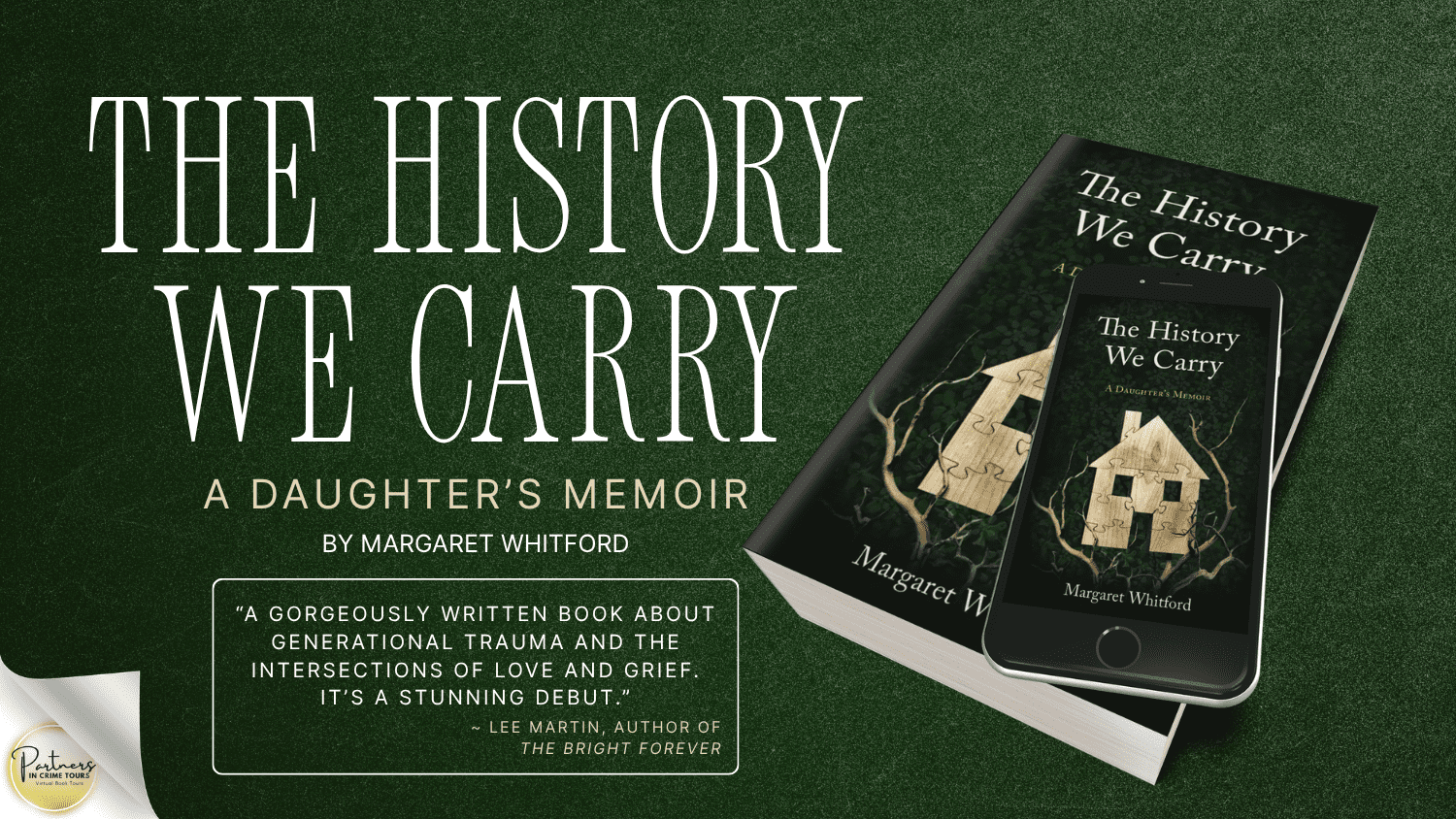
THE HISTORY WE CARRY
A Daughter’s Memoir
by Margaret Whitford
July 27 – August 21, 2026 Virtual Book Tour
Synopsis:
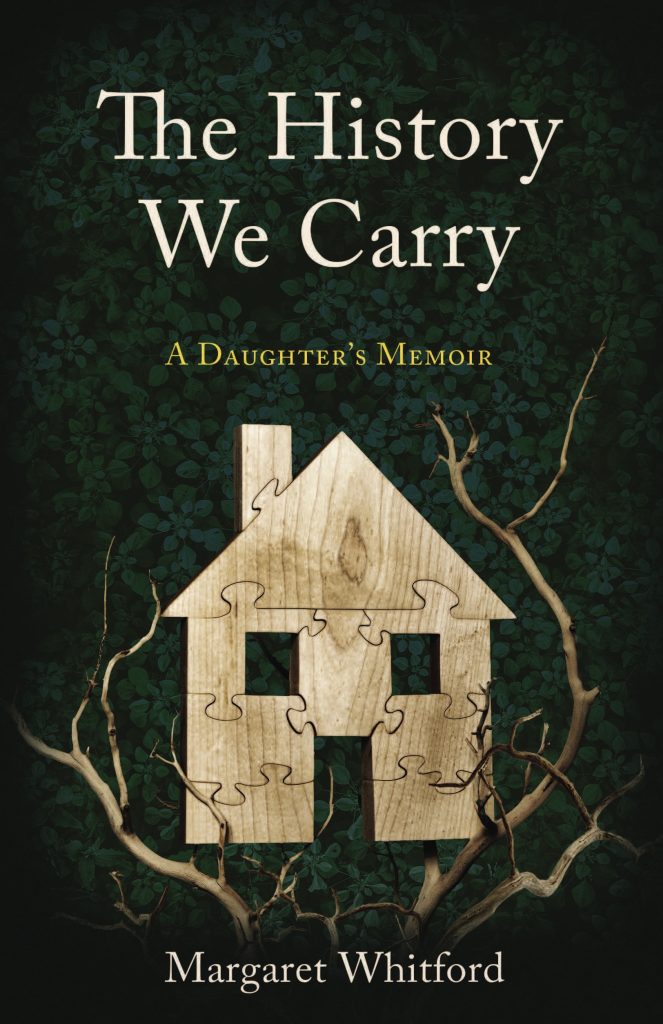
For fans of Jennette McCurdy’s I’m Glad My Mom Died, a memoir for daughters who recognize that to truly understand themselves and the patterns of their lives, they must first understand their mothers and the forces that shaped these women.
When Margaret Whitford’s mother was dying, she told those present that her daughter “had her history.” This was true; Margaret had conducted interviews with her mother during the last decade of her life. But this didn’t end their estrangement, and Margaret chose not to return to her mother’s side during her final days.
In this memoir, Margaret confronts this decision by unearthing in her mother’s traumatic history the roots of the emotional distance between them. She explores how a history marked by the devastation of World War II in Europe, a violent childhood home, and sexual assault accumulated into complex PTSD that shaped her mother and the way she parented Margaret as her firstborn and as a daughter—and, in turn, how Margaret carried her mother’s trauma forward in her sense of self, in her relationships to others, and in the ways she navigated her world. Indeed, Margaret not only had her mother’s history—she embodied it.
Ultimately, The History We Carry confronts the legacy of intergenerational trauma with wisdom and compassion, revealing how familial history shapes each of us but need not be wholly determinative of whom we become and how we choose to live.
Praise for The History We Carry:
“An unflinching, well-rendered memoir that generously encompasses love, trauma, and the fraught relationship between a mother and daughter.”
~ Kirkus Reviews (starred review)
“Margaret Whitford’s compelling memoir—a reflection on her family history, her relationship with her mother, and trauma that spans generations—is clear-eyed, compassionate, and often startling in its insight and originality. I was engrossed from beginning to end.”
~ Clifford Thompson, author of Jazz June: A Self-Portrait in Essays
“Rarely have I finished a memoir understanding how our histories, both personal and generational, live and breathe within us in the present. By unearthing the complicated and poignant relationship she has with her mother, Margaret Whitford also powerfully speaks to the collective soul-searching so vitally necessary during these trying times. Written in elegant, luminous prose, this is a memoir that will stay with you long after the story is told.”
~ Ken Harvey, author of The Book of Casey Adair
“Despite Tolstoy’s famous quote—families are generally neither happy nor unhappy—they are complicated, like Whitford’s. This important memoir delves into sibling conflict, parental infidelity, and substance abuse. Overlying these familial tensions is geopolitical upheaval and the effects of successive world wars, almost unwanted family members themselves. The History We Carry seats them together at its literary table and gives each their due in courageous, precise, and ultimately both urgent and forgiving prose.”
~ Sue William Silverman, author of Selected Misdemeanors: Essays at the Mercy of the Reader
“An exhilarating mix of memoir and deep personal research, The History We Carry explores a mother’s complex history and a daughter’s lifelong struggle to understand and connect with her mother. In clear prose that never presents simple answers but rather digs to discover unknown truths and questions even her own long-held narratives, Margaret Whitford has written a robust story of love and trauma.”
~ Sheryl St. Germain, author of 50 Miles
“All our parents live lives before we arrive, lives that come to bear on our own. In this new memoir, Margaret Whitford bravely ventures into her mother’s past to better understand her own present and future. The History We Carry is a gorgeously written book about generational trauma and the intersections of love and grief. It’s a stunning debut.”
~ Lee Martin, author of Pulitzer Prize finalist The Bright Forever
Book Details:
Genre: Dysfunctional Families, Motherhood, Bereavement
Published by: She Writes Press
Publication Date: June 2, 2026
Number of Pages: 256
ISBN: 9798896363224
Book Links: Amazon | Kindle | Barnes & Noble | BookShop.org | Goodreads | BookBub | She Writes Press | Simon & Schuster
Read an excerpt:
A World of Two
I picture my mother lying on her hospital bed, the same one she has occupied for the last twelve days. The space is in shadow, the only light coming from the hallway. The room smells empty. No flowers or scented candles—she wouldn’t have wanted those. The sound of retreating footfalls in the corridor or a muffled voice from another part of the hospital occasionally interrupts the silence. Her breathing is shallow, until the moment it stops altogether. It happens so quietly, no one notices at first.
When my mother died in Concord, I was an ocean away, in a Paris hotel. Another day had already started. That remove feels familiar—geography and time following an established pattern.
In the morning’s early hours, I lay next to my husband, Tom, on a king-sized bed in a room of marble-inlaid tables and still-life paintings in gilded frames, the walls covered in red-and-gold-striped paper. I heard only the sounds of the night, a faint breeze moving through the magnolia trees in the courtyard and an occasional car gliding along the boulevard. While Tom slept, I lay awake, thinking about my mother. I had started to understand that we wouldn’t make it back in time. My mother would either be dead or so unresponsive that there could be no last words between us.
Tom read my brother Billy’s email while I was taking a shower. I knew from the way he walked into the bathroom, but he still had to say the words: “Your mother is dead.” Years from now, I thought, I will be able to replay this moment in my mind. He stood there, naked, looking both vulnerable and strong, his hand on the shower wall ready to reach for me.
My brothers and sister wanted to touch our mother after she died because she had not welcomed that while living. She would allow a hug or a kiss in greeting or farewell but shrugged you off if you lingered in the embrace.
Henry would have stroked her sparse hair, cut short after she could no longer shape it into a twist. He might have teased her about finally being able to touch her hair, something she loathed. Lydia might have rubbed her feet, those odd feet, with such high arches her toes curled to reach the ground. Her feet shaped by childhood polio and old age, missing the little toe on one foot, removed because of frostbite suffered during the Second World War. She could never find comfortable shoes, so she wore Birkenstock sandals year-round, donning socks with them in winter.
Billy would have rested his hand on her shoulder, let his fingers travel the length of her arm. He might have held her hand, bent at strange angles by arthritis and with the bones loose under the skin. Had I been there, I would also have been drawn to her hands, so small that they reminded me of a child’s. She kept her nails short and immaculate, a habit she’d adopted in medical school, and one I try to emulate. I might have traced the line of her aquiline nose and the contour of her jaw, fondled her cheek and pressed my fingers to her high cheekbones, a sign of her Slavic heritage, she once told me.
Her sandals and the pair of socks she last wore with them are mine now, safeguarded in a box in the back of my closet. Those Birkenstocks, the insoles shaped over time by the pressure of her feet, her navy-blue socks. I wanted the last of her clothing, something that had touched her. I run my hands over the smooth cork, hold the socks to my cheek, the much-washed cotton soft. I thought the socks might retain the cool, dry scent of her.
Our plane to Massachusetts departed in the afternoon, so Tom and I filled the morning with small errands—the purchase of a journal of good paper with a red ribbon to mark my place—and one last view of Notre-Dame. Each gesture, every step I made, accompanied by a voice in my head repeating, Your mother is dead.
The air smelled of diesel fuel and wet earth. My left arm entwined with Tom’s right, I rested my hand on his steady forearm, eavesdropped on the conversations around me, catching only phrases. I thought how these strangers knew nothing of my grief and I nothing of theirs. A rare winter’s morning, fresh with rain-washed skies, and sunlight bathing the bone-colored stone of centuries-old buildings. I noticed the quality of the light, its unusual clarity. Tom and I had introduced my mother to Paris on a trip years before. She will never see it again, I thought, trying to absorb its beauty on her behalf.
***
Excerpt from THE HISTORY WE CARRY by Margaret Whitford. Copyright 2026 by Margaret Whitford. Reproduced with permission from Margaret Whitford. All rights reserved.
Author Bio:

Margaret Whitford served in leadership positions within the nonprofit world for twenty years, including ten years in the social justice field, before turning to writing. She is fascinated by the ways in which we all seek to create places of refuge for ourselves, both in a metaphorical and a physical sense. The History We Carry is her first memoir. An avid Francophile, Margaret, with her husband, divides her time between a small village in the South of France and her home in Concord, Massachusetts.
Catch Up With Margaret Whitford:
MargaretWhitford.com
Amazon Author Profile
Goodreads
Instagram – @margaretwhitfordwriter
Facebook
Tour Participants:
Tour Host Info:
Book Formats: ePub, Print
Hosting Options: Review, Interview, Guest Post, Showcase
Giveaway: There will be a tour-wide PICT Giveaway
Join In:
Thank you for your interest in this tour. We are no longer accepting hosts for The History We Carry. Please visit our open tours page to sign up for a current tour.