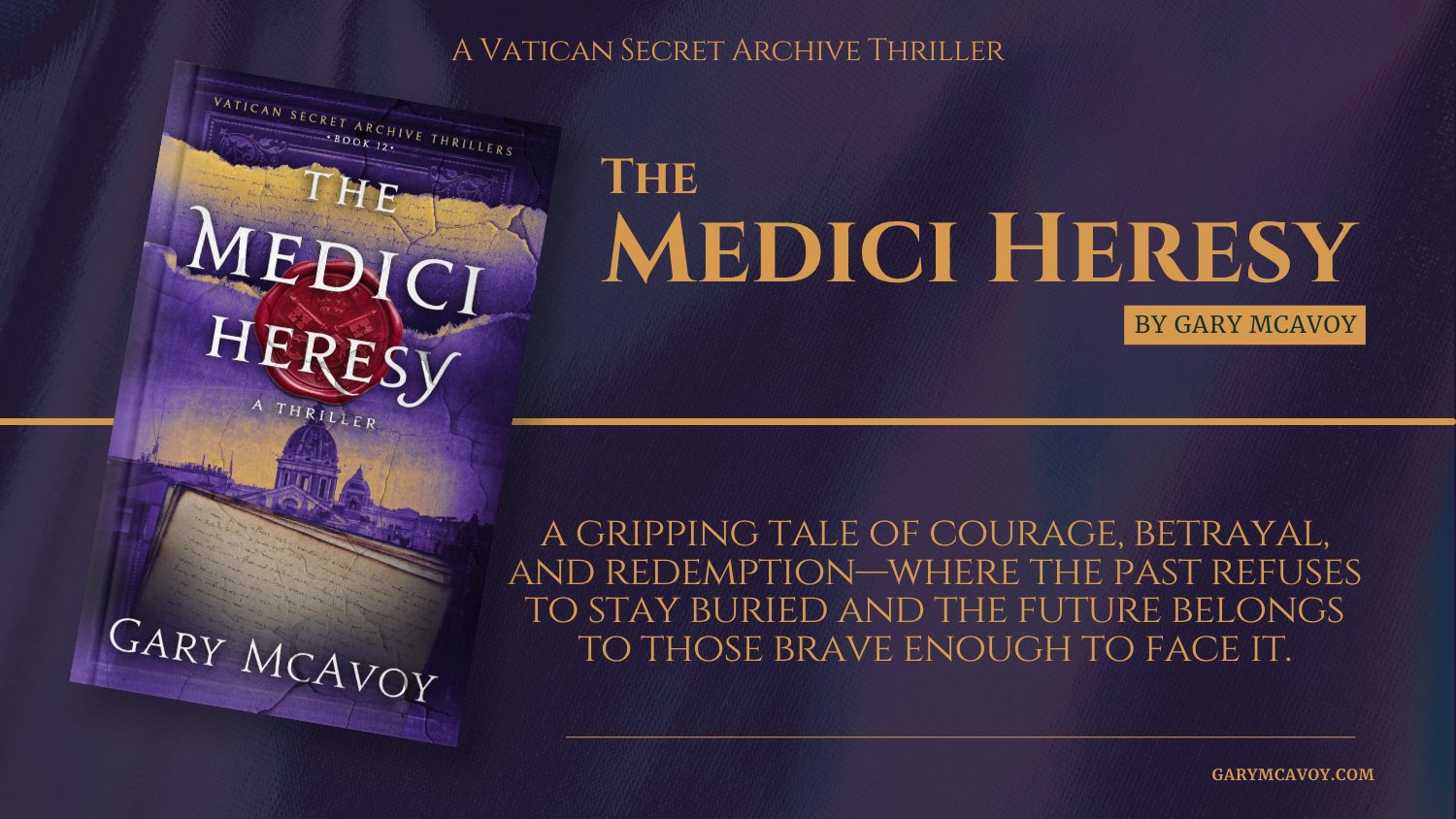
THE MEDICI HERESY
by Gary McAvoy
November 2 – 27, 2026 Virtual Book Tour
Synopsis:
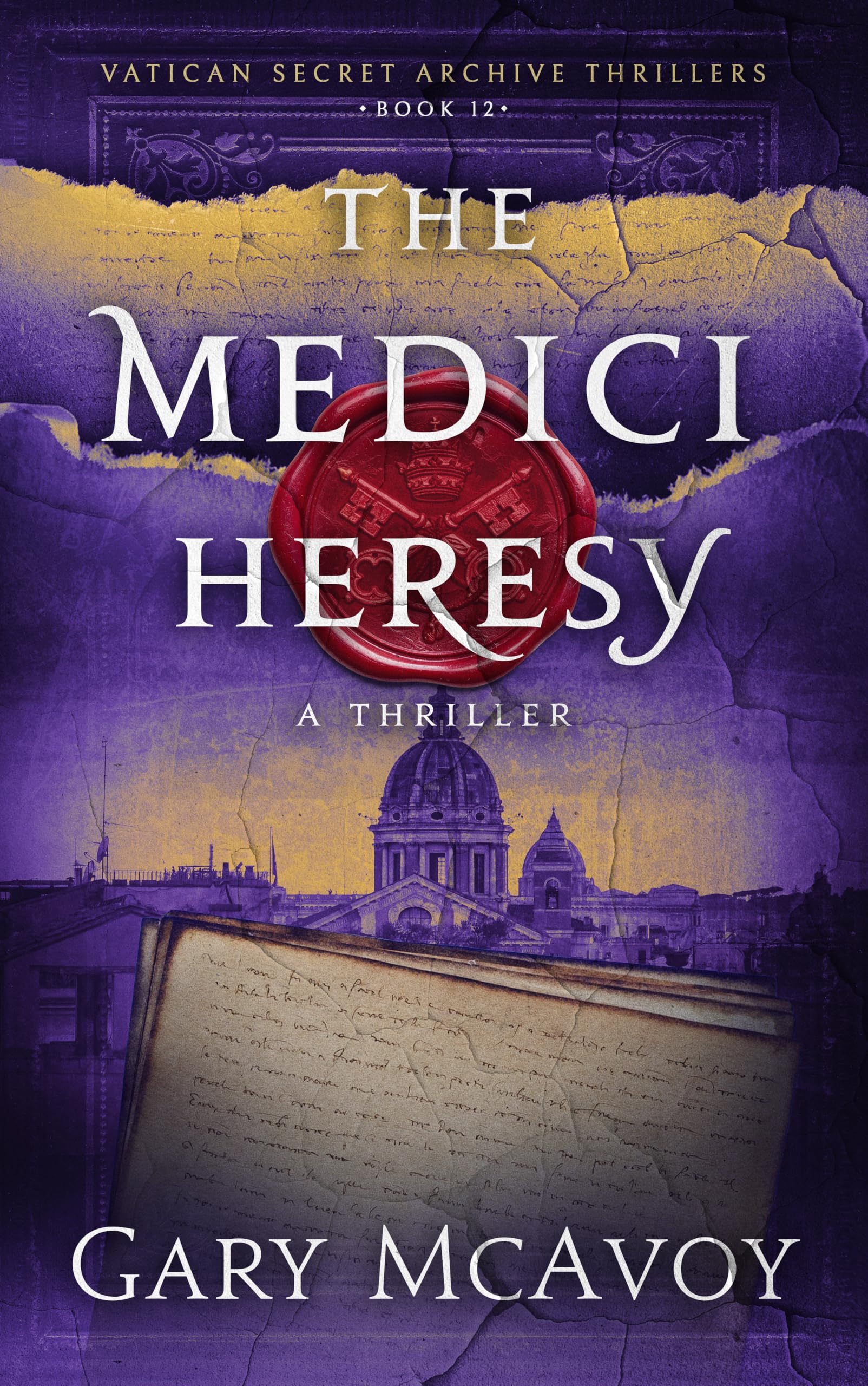
A Vatican Secret Archive Thriller
When Father Michael Dominic uncovers a sealed Renaissance letter hidden deep within the Vatican Archives, he awakens a five-hundred-year-old secret buried by Pope Clement VII at the height of the Medici dynasty. Joined by investigative journalist Hana Sinclair, Michael follows a trail of clues through forgotten chapels, papal confessions, and ancient astronomical alignments, each step drawing them deeper into a mystery the Church once swore to silence. What begins as a scholarly puzzle quickly becomes a struggle for survival as shadowed forces—both inside and outside the Vatican—move to control or destroy what Clement left behind.
Their search reveals two extraordinary manuscripts: the Gospel of the Beloved, attributed to Mary Magdalene, and the Codex of Voices, a Renaissance record documenting the Church’s attempt to bury it forever. As Michael, Hana, and their Swiss Guard allies navigate the danger closing in around them, they confront a truth that challenges not doctrine but conscience: why some voices endure across centuries while others are violently erased. With each revelation, the line between faith and fear grows thinner, and the cost of honesty becomes terrifyingly clear.
Rich in historical detail and steeped in Vatican intrigue, The Medici Heresy weaves a modern thriller through one of the Church’s darkest chapters. From Medici Florence to the underground chambers beneath St. Peter’s Basilica, Gary McAvoy delivers a gripping tale of courage, betrayal, and redemption—where the past refuses to stay buried and the future belongs to those brave enough to face it.
While part of the Vatican Secret Archive Thrillers series, The Medici Heresy is a standalone adventure that can be enjoyed by new readers and longtime fans alike.
Praise for The Medici Heresy:
“A guilty pleasure! I’ve read all of these books in the series and love anything about Mary Magdalene. The rain became an oppressive character and seems like would have prevented them seeing the light coming through the aperture to find the hidden compartment of the sixth or so letter. I appreciate that the author distinguishes fact and fiction at the end of the book and hope he does not run out of archives to chase down.”
~ Karin
“Bravo…..again!!! You keep me captivated! I look forward to the next story in the archival series. I adore every one of your characters, good and bad. Please keep writing.”
~ Karen Veltman
“Great read! Gary McAvoy’s novels are all exciting and filled with historical references …but I truly enjoyed this novel the most—he has a way of painting pictures with words.”
~ Amazon Customer
The Medici Heresy Trailer:
Book Details:
Genre: Vatican Historical Thrillers
Published by: Literati Editions
Publication Date: November 25, 2025 | HC
Number of Pages: 394 | HC
ISBN: 9781954123786 (ISBN10: 1954123787)
Series: A Vatican Secret Archive Thriller, Book 12 || Stand Alone
Book Links: Amazon | Kindle | Barnes & Noble | BookShop.org | Goodreads | BookBub | Gary McAvoy Books
Read an excerpt:
Vatican City, Present Day
Father Michael Dominic cherished mornings the way a monastic scribe once revered a well-cut quill: not as luxury, but as necessity. In the hushed corridors beneath the Apostolic Palace, where the sunlight filtered weakly through narrow glass slits and history exhaled dust from every shelf, he found peace in routine.
Each morning began before the bells. Rising at five, he slipped into the worn cassock that had traveled with him from his Jesuit seminary days, now threadbare at the cuffs but softened with memory.
But for his pre-dawn run, the cassock stayed folded on its hook. Michael preferred the quiet streets before sunrise—the echo of his footsteps on cobblestone, the scent of baking bread drifting from Trastevere, the soft hum of Rome preparing to wake. When he circled back toward the Borgo, sweat cooling on his skin, he made his customary stop at Pergamino Caffè just outside the colonnade.
Signora Palazzolo, who had run the tiny shop since her husband’s passing, spotted him through the window before he reached the door. She bustled out from behind the counter with a small bundle wrapped in brown paper. “Padre Dominic,” she said, wagging a finger at the sight of his running clothes, “the Holy Father may tolerate many things, but not a priest entering the Vatican dressed like a marathoner.”
Michael smiled. “You spoil me, Signora. You know that, don’t you?”
“I preserve your dignity,” she corrected, pressing the parcel into his hands. Inside was a freshly laundered cassock—one of two she kept for him, neatly sewn and ironed, refusing payment beyond a whispered blessing. “The restroom is free. Go, go. Before the guard at Sant’Anna thinks you’ve lost your vocation.”
He thanked her, ducked into the small restroom at the back, and splashed cool water on his face until the last traces of sweat faded. He unwrapped the cassock, slipping into the familiar black fabric and fastening the collar with practiced ease. The transformation was always the same: from runner to priest, from solitude to service.
When he stepped back into the café, Signora Palazzolo handed him a steaming paper cup. “For the road,” she said. “And tell the Swiss Guard I said buongiorno.”
Michael grinned, lifted the coffee in a small salute, and stepped into the crisp morning air. The Porta Sant’Anna gate waited a short walk away, its stone arch flanked by the bright uniforms of the Swiss Guard—his threshold to a world of parchment, secrets, and the quiet weight of history waiting to be unsealed.
Father Michael Dominic did not resemble the image most people carried of a Vatican archivist. Tall and athletically toned, with long black hair often tied back and deep brown eyes that missed little, he moved with the quiet confidence of someone accustomed to slipping between worlds—faith and doubt, past and present, obedience and inquiry. Raised in Queens by his devout mother, the housekeeper of the parish rectory, Michael had spent his childhood in the company of priests, altar candles, and shelves of worn theological books. It was Father Enrico Petrini, the parish’s pastor and the closest thing Michael had ever known to a father, who nurtured his restless curiosity and encouraged him toward the priesthood long before Michael understood what such a calling would demand.
He went on to study paleography at the Pontifical Institute at the University of Toronto and theology at the Gregorian University, credentials that earned him a coveted post in the Vatican Apostolic Archives. But what truly distinguished him was not his scholarship—it was his temperament. Michael approached hidden truths with the humility of a believer and the relentlessness of an investigator, guided by a conscience that refused to ignore what others preferred to bury. He possessed an almost unsettling ability to sense when history had been bent or softened for convenience, and he had learned that the Church’s oldest secrets rarely slept quietly. In Rome, that made him invaluable—and, at times, dangerous to those who feared what he might uncover next.
His key—a heavy, iron-forged piece given only to him as Prefect and to two deputies—turned with a low click in the Archives’ bronze door. The great subterranean labyrinth beyond stirred only with the hum of climate controls and the occasional scurry of mice that had somehow defied Swiss Guard extermination efforts for generations.
He always entered alone.
Descending the spiral stone staircase into the belly of the Vatican, Michael would pause briefly before the marble sculpture of St. Lawrence, patron saint of archivists. The statue stood solemn watch in the vestibule, his martyr’s gridiron beside him, eyes uplifted as if still seeking light in the depths. Michael touched the cool marble of its base, murmuring a quiet invocation in Latin: “Custos silentii, ora pro nobis”—Guardian of silence, pray for us.
Then began the work.
Today had begun like any other. He had donned his archivist gloves, retrieved his logbook, and walked the long central corridor toward the restricted manuscript chamber. The hum of dehumidifiers formed a familiar backdrop to his thoughts. A new cataloging project awaited—three fifteenth-century codices donated by the Archdiocese of Seville, each wrapped in cloth and tagged in Vatican gray. He had been preparing a report for the Cardinal Librarian on the authenticity of their bindings. Nothing about the day had suggested interruption.
But at precisely 9:43 a.m., as the daily delivery from the Vatican Post Office arrived via pneumatic tube—a sleek, hissing canister that thudded gently into the brass receptacle near his desk—his day unraveled.
The canister clunked against the metal lip with more force than usual.
Michael turned with mild curiosity. Inside was the usual: interdepartmental memos, two periodicals, and a sealed envelope marked Bibliotheca Apostolica Vaticana. But below them was something he didn’t recognize: a flat parcel wrapped in vellum, the edges tied neatly with deep burgundy ribbon. It bore no address, only his name—P. Michael Dominic—written in looping script that instantly evoked another age.
He stared at it for a long moment before touching it.
The handwriting was unlike any he had seen in modern routine Vatican correspondence. Ornate, yet disciplined. The capital “P” had a serpentine curl; the “M” was double-looped in the style of Renaissance scribes. Someone had gone to great lengths to mimic or preserve an earlier penmanship, complete with sepia-toned ink. There was no seal, no watermark, no sender’s mark on the reverse. Just a small, embossed Medici crest faintly pressed into the parchment—a shield bearing six spheres and a lily crown.
His pulse stirred.
He turned the envelope in gloved hands. The sender had access to the Vatican’s internal postal network. That narrowed the list considerably—and dangerously. Only a handful of people were authorized to send mail directly to the Secret Archives via internal courier. Which meant one of two things: either a trusted insider had left him a relic—or someone had breached the Vatican’s most secure internal system with cunning precision.
Either way, it would require discretion.
Michael slipped the package into his document satchel and continued his day as if nothing had happened. But the weight of the thing—though barely a few ounces—gnawed at the back of his thoughts like a thread working loose in a tapestry.
Later, after lunch in the Sala Clementina with two fellow scholars, he retreated to his personal workroom. It was a modest chamber tucked off the northeast passage—just large enough for a desk, three chairs, and a carved wood icon of St. Jerome, patron saint of librarians and biblical scholars, in his study—a fitting presence in a place where symbology saturates every hallway, painting, and page, speaking in codes as ancient as the Church itself. The room smelled of old oak, wax polish, and aging paper.
He shut the door, drew the curtains, and sat.
With deliberate calm, Michael untied the ribbon.
Inside was a folded letter on parchment that had yellowed with age but remained pliant, as if it had been lovingly preserved. No brittle edges, no flaking. The ink had faded in parts, but the script remained legible—calligraphic Latin in a bold humanist hand. The opening line read:
Ad futurum pontificem, qui veritatem non timebit… “To the future pontiff who shall not fear the truth…”
Michael leaned forward, his breath shallow.
The salutation alone stirred unease. Not merely because of its boldness—but because of the signature. Faint, in the lower corner, faded but unmistakable:
Clemens VII, Pontifex Maximus
For several long moments, he stared at the name.
Clement VII—Giulio de’ Medici—was one of the most politically embattled popes in Church history. His papacy had spanned the brutal Sack of Rome, the rise of the Protestant Reformation, and desperate diplomatic dances with Francis I and Charles V. The idea that Clement had left behind a secret letter—undocumented, unarchived—was staggering.
But then he read on.
Rome, the Feast of St. Mark the Evangelist, Anno Domini 1533
To my successor, in whose soul doubt may rise like smoke from Sinai—
If you are reading this, the tide of silence has receded. The world has changed—or will. This manuscript is not false. But neither is it safe. You must decide what to do with it, as I have decided only to protect it…
I write not as Sovereign Pontiff, but as one burdened by knowledge too fragile to bear the papal seal. There are truths which the Tiara cannot touch without unraveling, and it is such a truth that now coils around my soul like incense refusing to dissipate.
In my final years, the Lord permitted that a document should reach my hands—unbidden, and unblessed. It was not borne by nuncio or legate, but by a friar whose hands trembled with reverence and whose lips bled from silence. He died three days after its delivery, whether from fever or fear, I cannot say. What he brought was not a heresy, nor an apocryphon in the usual mold. It bore no mark of Gnosticism or madness. It was, in its way, painfully lucid.
It claimed to be a testimony. Not from a prophet, nor from one of the Twelve—but from her who stood beside Him in death and rose to proclaim Him living. From the one whom Rome later draped in penitence and shame.
I will not name her here. You know of whom I speak.
The words within that document are carved in the flesh of theology. They do not merely challenge our structures—they undo them. They proclaim a communion without hierarchy, a grace without ordination, a love that refuses the architecture we have so diligently erected over centuries.
In reading it, I felt both awe and vertigo. It was as though a familiar cathedral were shown to me upside down: beautiful still, but terrifying in its reordering of heaven and earth.
And so I ask: What if the first church was not built upon a rock, but upon tears?
I have not destroyed this document. Nor have I revealed it. I have preserved it—sealed it—until such time as Providence should declare a soul ready not merely to possess it, but to be possessed by it.
If this letter has reached you, that time may be at hand.
But beware: the key does not turn for the ambitious, nor the curious. It opens only to the one who approaches with fear and truth in equal measure.
You must not seek clarity from this letter alone. There are others—seven more—written in silence, placed like stepping-stones for the heart to follow. Some will lead you backward in history. Others, inward into conscience. All will ask more than they answer.
I could not entrust the full weight of this truth to any single hand, lest it be crushed under the pressures of cowardice or ambition. Let these eight letters, scattered across the bones of Christendom, call forth only the one willing to walk the full Via Veritatis—the road of truth.
To begin, I offer this:
Follow the ink that weeps gold.
It stains only those prepared to be marked.
Seek not the treasure first, but the wound that precedes it.
With trembling hand,
✠ Clemens PP. VII
Pontifex Maximus
Michael stared at the final lines, reading them again and again, as if repetition might clarify what Clement had deliberately veiled. Follow the ink that weeps gold… The phrase lingered like incense after Mass—haunting, poetic, elusive.
The script was genuine. The watermark faint but distinct. The Medici crest, a subtle impression on the lower corner, sealed the letter’s pedigree like a fingerprint from history. But it wasn’t the external clues that disturbed him. It was the voice.
This wasn’t some elaborate forgery or theological curiosity. It read like a confession. A burdened man on the edge of death writing to posterity—not with pride, but with trembling hope. And if Clement’s words were true, he had held something that defied not only doctrine, but the very foundations of the Church’s authority.
A gospel. Written not by one of the Twelve, but by her. The first witness. The Beloved.
Michael sat motionless for nearly ten minutes. He did not take notes, nor reach for his cataloging software. Instead, he simply absorbed the implications, each one heavier than the last.
Who had brought this to him? Who had waited nearly five centuries to let it breathe? And why now?
At last, he reached for his secure tablet and composed a brief text message to the one person whose instincts he trusted as much as his own: Meet me by the Cortile della Pigna at sunset. We have a ghost from the Renaissance who wants to speak to us.
They met beneath the towering bronze pinecone of the Cortile della Pigna, a relic of pagan Rome now perched like a fossilized thought in the Vatican’s Renaissance courtyard. The hour was shifting, twilight dissolving into dusk, and the last of the sun lay like a fading brushstroke across the travertine walls.
Hana Sinclair was already there, seated near the fountain. She wore a slate-gray linen jacket over her blouse, the soft glow of the courtyard lamps catching in her hair. A reporter’s notepad rested loosely in her lap, more instinct than necessity, like a catechism waiting to be opened. When she saw him approach, she rose and tucked the notebook into her jacket.
Hana had the air of someone who carried her own weather with her, a quiet intensity softened by a quick, discerning intelligence. She carried the poise of someone who had learned to listen before she spoke—a trait that had made her one of Le Monde’s most respected investigative correspondents. Paris had shaped her manner, but Rome had sharpened her instincts, and nothing in the Vatican surprised her anymore. Except, perhaps, the way Michael looked at her now, with the quiet certainty of a man whose life had shifted after a single sealed parchment.
The reforms enacted by the late Pope Ignatius, allowing priests to marry under specific conditions, had changed both their futures. After years of shared danger, whispered trust, and unspoken affection, Michael and Hana were now engaged—a truth they held gently between them, as private and steady as breath. The Church was still adjusting. So were they.
“You sounded… urgent,” she said.
Michael Dominic glanced around, quietly noting the open archways and shadowed windows above. No guards lingered. The clatter of tourists had long since faded. A nun passed quietly to the west, rosary in hand. They were, for the moment, alone.
Only then did he draw the archival sleeve from his satchel and hand it to her.
She took it without a word, her fingertips brushing his for a moment before she stepped aside to read. As the last of the sun poured over the courtyard, she opened the parchment and let her eyes drift down its lines.
Her lips moved silently. Her breath grew shallow. By the time she reached the final passage—“Seek not the treasure first, but the wound that precedes it”—her expression had darkened with something between awe and apprehension.
She looked up slowly.
“Michael… this isn’t just a letter. This is a riddle. A lament.” Her voice was barely above a whisper. “It doesn’t name the gospel, doesn’t describe it… but the implications are—”
“Devastating,” he finished. “If they’re true.”
“Clement read something he couldn’t burn. And couldn’t share.” She shook her head. “He wasn’t protecting the Church. He was protecting its image. Its structure.”
Michael nodded. “It shook his confidence in the very thing he was meant to uphold.”
Hana reread a line, eyes narrowing. “‘The one whom Rome later draped in penitence and shame…’ That’s Mary Magdalene. It has to be. He’s all but saying it.”
“And he calls her the first to proclaim the Resurrection.”
She folded the parchment and exhaled slowly. “So the gospel Clement received… if it exists… rewrites apostolic authority. It places her at the center, not Peter. Not the hierarchy. Not the priesthood.”
Michael said nothing.
“And this line here—‘follow the ink that weeps gold’—is he sending the reader to another letter?”
“I think so. There’s a path he’s designed. Breadcrumbs across time.”
Hana frowned. “Why? If he wanted to suppress it, why leave clues at all?”
“Because he didn’t want it lost forever. Only buried until someone was ready.” Michael’s tone was quiet. “And he thought that person might be a future pope.”
“But instead it landed in your hands.” She tilted her head. “Do you think this was meant for you?”
He hesitated. “I think… someone inside the Curia wanted it to be.”
Hana looked sharply at him. “An insider?”
“It came through internal channels. Quietly. Discreetly. That takes access.”
“Then this wasn’t a leak. It was an invitation.” Her brow furrowed. “Or a trap.”
Michael nodded grimly. “That’s what I don’t know. If they wanted to reveal the gospel, they’d go to the media. Or scholars. Not to me. Not like this.”
“You think someone’s testing you.”
“Or baiting me. Either way, it’s calculated.”
She stared at him, her voice now edged with urgency. “If what Clement saw was real… it would shake every theological pillar on which the Vatican rests. Not just women’s roles, but the idea of hierarchical grace, apostolic succession… even priestly absolution.”
“It would democratize the divine.”
“And the moment that idea gains traction…” Hana didn’t finish the sentence. She didn’t have to.
They sat in silence for a long moment. As the sun dipped behind Rome’s ochre rooftops, a low peal of bells rolled across the city, solemn and resonant. From the dome of St. Peter’s to the shadowed courtyards of Trastevere, the call to Vespers drifted through alleys and over piazzas like a blessing carried on evening air. The sounds were peaceful, but the feeling between them was not. It was the stillness before a fracture.
Finally, Michael rose.
“I’ll scan the letter tonight,” he said. “Privately. No logging. I’ll cross-check Clement’s handwriting and reach out to Florence for ink comparison. Quiet channels only.”
“And I’ll begin pulling every known piece of Clement’s private correspondence from his final year,” Hana said, rising beside him. “Any marginal notes, off-ledger entries, even librarian rosters. If there are more letters, they may already be hidden in plain sight.”
He nodded. “And if this is only the first of eight…”
“Then we’ve barely scratched the surface.”
They walked from the courtyard slowly, side by side, shadows stretching long behind them.
Above, the dome of St. Peter’s loomed in silhouette, serene and immovable. But somewhere beneath its weight, truth had begun to stir. And this time, it would not return to silence easily.
***
Excerpt from The Medici Heresy by Gary McAvoy. Copyright 2025 by Gary McAvoy. Reproduced with permission from Gary McAvoy. All rights reserved.
Author Bio:
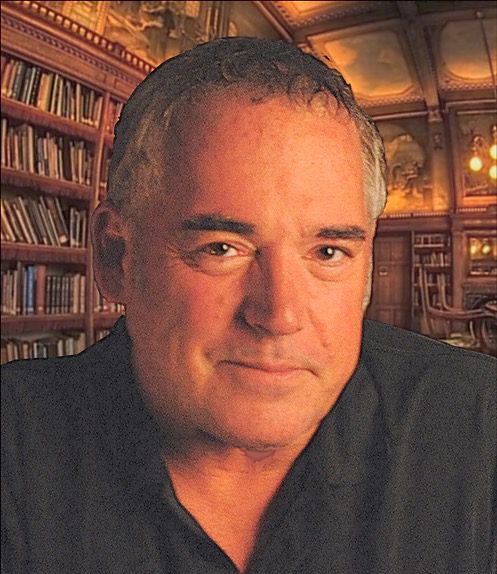
Gary McAvoy is an American novelist known for internationally bestselling thrillers that blend historical intrigue, religious scholarship, and modern suspense. A lifelong researcher of rare manuscripts and Church history, he draws on extensive archival study to craft narratives rooted in authentic detail. His work includes the Vatican Secret Archive Thrillers, the Magdalene Chronicles, and the Vatican Archaeology Thrillers. Before turning to fiction, McAvoy built a distinguished career as an entrepreneur, technology consultant, and collector of historical documents. He now writes full time from the Pacific Northwest, where he continues to explore the shadowed crossroads of faith, power, and history.
Catch Up With Gary McAvoy:
GaryMcAvoy.com
Amazon Author Profile
Goodreads – @garymcavoy
BookBub – @garymcavoy
Instagram – @gary_mcavoy
X – @GaryMcAvoy
Facebook – @GaryMcAvoyAuthor
Tour Participants:
Tour Host Info:
Book Formats: ePub, Print, Audiobook
Hosting Options: Review, Interview, Guest Post, Showcase
Giveaway: There will be a tour-wide PICT Giveaway
More: According to the author The Medici Heresy is considered to be PG-level content or less. Readers may still encounter potentially sensitive material. If you have specific trigger or content concerns, please contact Partners in Crime Tours directly for more detailed information.